Why did they stop making moai?
Rano Raraku still holds around 400 unfinished moai. Why the carving stopped, what the collapse debate really says, and how the birdman cult took over.
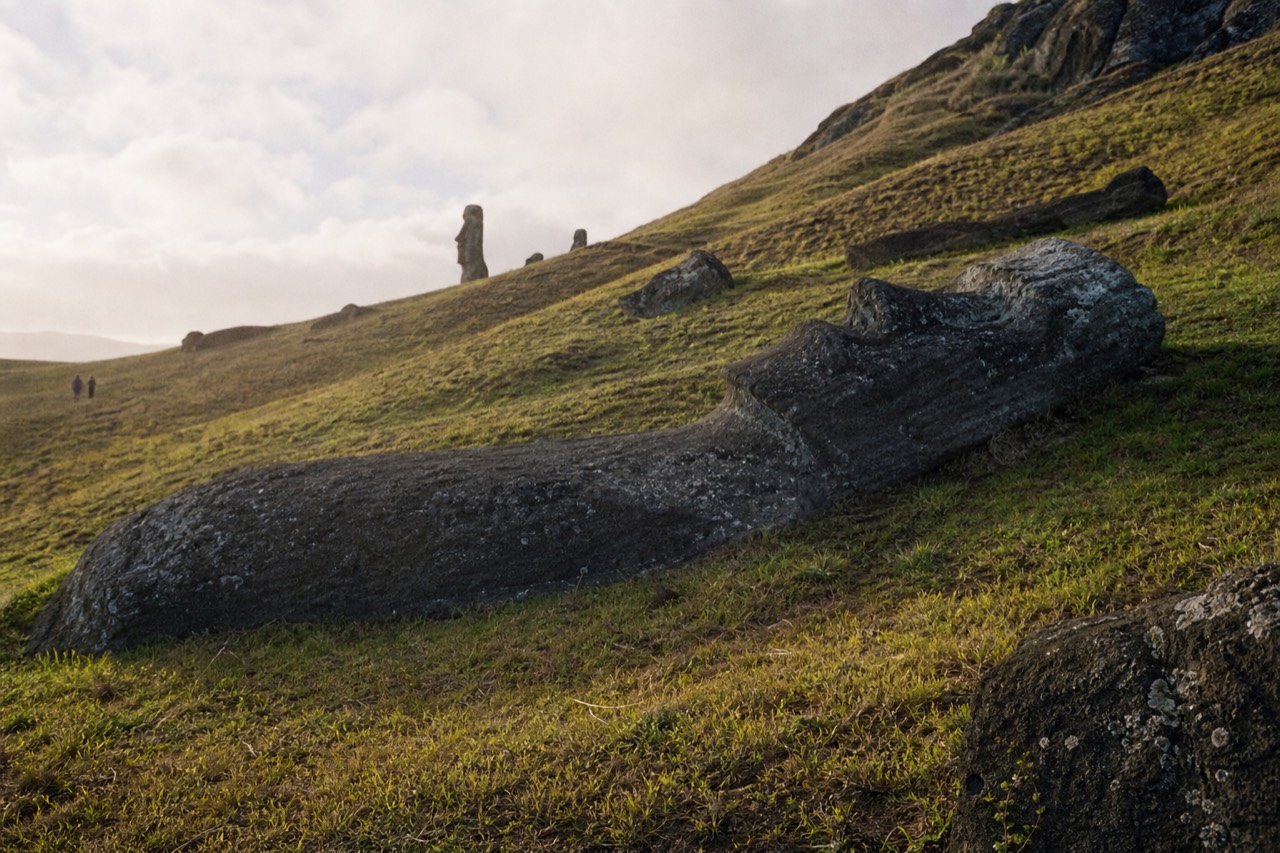
On the outer slope of Rano Raraku, one moai lies on its back with its spine still fused to the bedrock. Nobody ever cut it loose. Around it, half-swallowed by grass and volcanic ash, sit hundreds more at every stage between rough block and finished figure. The national park counts 400 statues in various stages of work at that one site.
It does not read like a monument. It reads like a workshop where a shift ended and nobody came back the next morning.
So what made the carving stop?
No single cause is settled, and the strongest reading of the evidence is a shift rather than a switch. The island's resource base changed, the political system that paid for statues changed with it, and ceremonial energy moved to a different place and a different cult. European arrival then reshaped everything again. Anyone offering one tidy reason is skipping the argument.
Start with what a moai cost. The tallest one ever raised on a platform, Paro, stands close to 10 metres and weighs around 82 tonnes, and the heaviest erected example, a squatter figure at Tongariki, comes in near 86 tonnes. Unfinished giants still in the quarry would have run to roughly 21 metres and between 145 and 165 tonnes had anyone moved them. Multiply that by around 300 ceremonial ahu platforms around the island and you are looking at centuries of organised labour, food surplus, rope, timber and command.
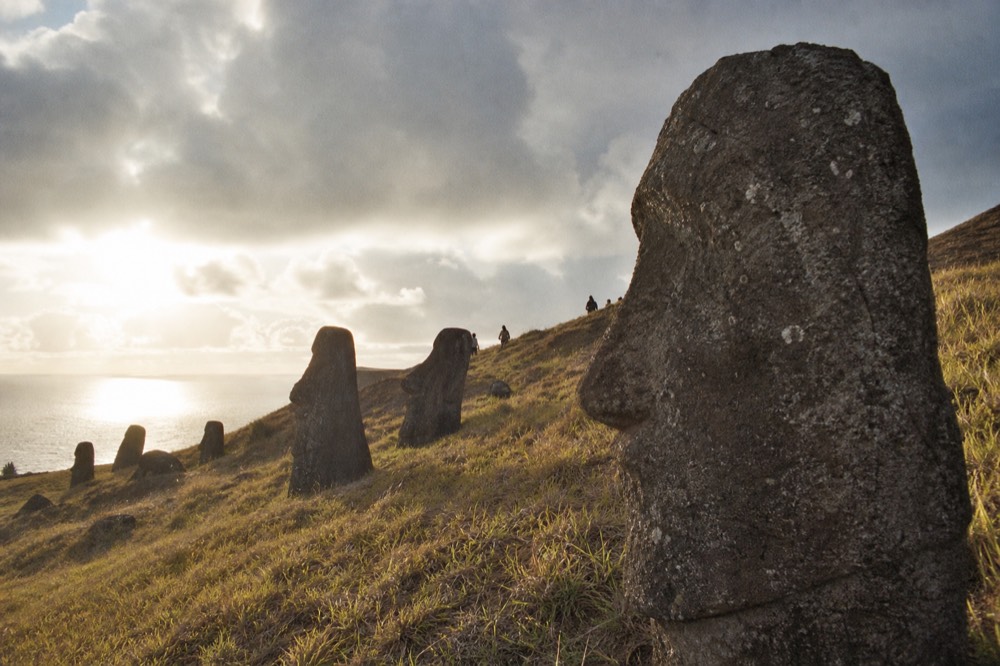
Then look at transport, where the system was most fragile. A 2025 round of research used drones and physics modelling on 62 statues abandoned along the island's old roads, and found base and cross-section features supporting the long-argued "walking" hypothesis: moai rocked upright along prepared tracks rather than dragged flat. Whatever the method, it needed people, coordination and material. Take away one of the three and the statues stop moving, whether or not anyone has decided to stop carving them.
What does the quarry actually show?
Rano Raraku holds the largest single concentration of moai anywhere, and the published counts disagree because they are counting different things. The park's own site description says 400 statues in various stages. The long-standing archaeological tally for the quarry is 887. The Easter Island Statue Project has inventoried 1,040 monolithic sculptures island-wide.
| The number | Where it comes from | What it actually counts |
|---|---|---|
| 1,040 | Easter Island Statue Project inventory | Monolithic sculptural objects logged island-wide, in every condition |
| 900+ | The national park's own headline figure | Moai on the island, rounded for visitors |
| 887 | Long-standing archaeological tally for the quarry | Moai remaining at Rano Raraku specifically |
| ~400 | The park's site description of Rano Raraku | Statues at the quarry described as being at various stages |
| ~397 | Lower published quarry counts | A narrower definition of what qualifies as a moai |
| ~300 | UNESCO and park estimates | Ceremonial ahu platforms island-wide, not statues at all |
The gap between 887 and 400 is not sloppiness. It is the difference between counting every fragment, blank and partial carving on the slopes and counting the figures a visitor recognises as statues. One 2020 dataset of 809 recorded remains at the quarry classified around 59.7% of them as moai, which tells you how much rubble sits alongside the famous heads. The statue project's own inventory is the closest thing to a master list.
What matters here is simpler than any of the totals. Work at Rano Raraku stopped while jobs were open, with statues at every stage of an unbroken production line, including one still attached to the rock it was being cut from. Production lines do not usually end that way after a slow, negotiated wind-down.
Did the island really cut down all its trees?
The forests did go, and the loss was largely complete before Europeans arrived. What is genuinely contested is the cause and the consequence. Recent work points at a combination of human clearing and rats eating palm seeds, and a 2024 ancient DNA study found no genetic evidence for the population collapse the ecocide story requires.
The palms at Anakena that appear in every photograph of that beach were planted in 1960, imported, long after the island's original palm forest had gone. That single fact does more work than any argument: the postcard version of Rapa Nui is a replanted landscape.
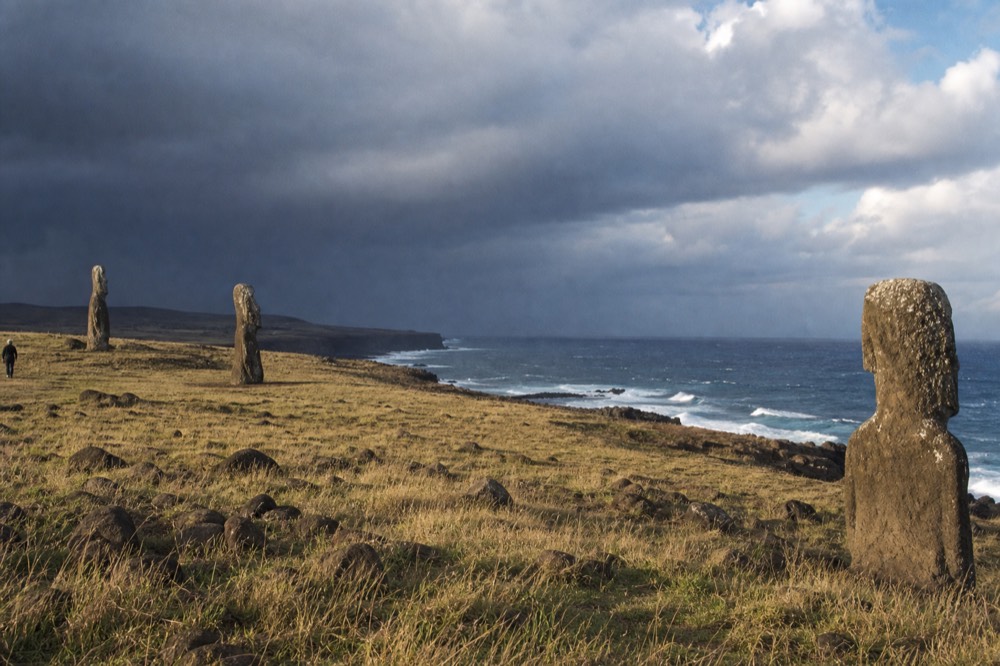
Where the popular telling overreaches is the next step, the one that turns deforestation into societal suicide. Ancient DNA published in 2024 found no evidence of the sharp pre-contact population crash that story depends on, and 2025 studies of transport and deforestation put real weight on Polynesian rats, which arrived with the first canoes and ate palm seeds faster than the palms could replace them. A society can lose its forests, adapt, and keep going. That claim is doing better in the literature than it did twenty years ago.
Guides on the island live inside this debate, and the ones working the archaeological circuits will tell you which parts are consensus and which parts are contested. If that argument is the reason you are flying five and a half hours across the Pacific, it is worth checking what a private archaeology day costs on your dates. The longer version of the story, about the people rather than the trees, sits in the honest account of the island's tragedy.
What replaced the moai?
The birdman cult, centred on Orongo. Ceremonial life moved from ancestor statues on coastal platforms to an annual competition at a stone village on the rim of the Rano Kau crater, where contestants raced for the first sooty tern egg from the islets below. The two centres are the clearest before and after in the island's archaeology.
Orongo sits on the crater edge looking out at Motu Nui, Motu Iti and Motu Kao Kao, the three islets that gave the Tangata Manu contest its finish line. It is a different kind of sacred place from an ahu: low stone houses, petroglyph panels, a view built for watching. Where the moai embodied ancestors facing inland over their descendants, the birdman rite handed authority to whoever won a race each year.
| Rano Raraku | Orongo | |
|---|---|---|
| What it is | The main statue quarry, 400 figures at various stages | Ceremonial village of the Tangata Manu, the birdman cult |
| What it faces | The plain running down toward Tongariki | The islets Motu Nui, Motu Iti and Motu Kao Kao |
| What survives | Unfinished moai, roughouts, one still attached to bedrock | Stone houses, petroglyphs, the crater lake below |
| Ticket rule | Single entry per park ticket | Single entry per park ticket |
| Which day covers it | The south and east coast circuit | The Orongo and Rano Kau circuit |
The single-entry rule is the practical sting in that table. Your park ticket runs 10 consecutive days, but Rano Raraku and Orongo each admit you once, so a rushed first visit to either one cannot be repaired later in the week. Anyone who wants the birdman side of the story properly should look at which days run the Orongo and caves circuit before locking the rest of the itinerary. The full moai explainer covers the carving and transport side in more depth.
Who pulled the moai down?
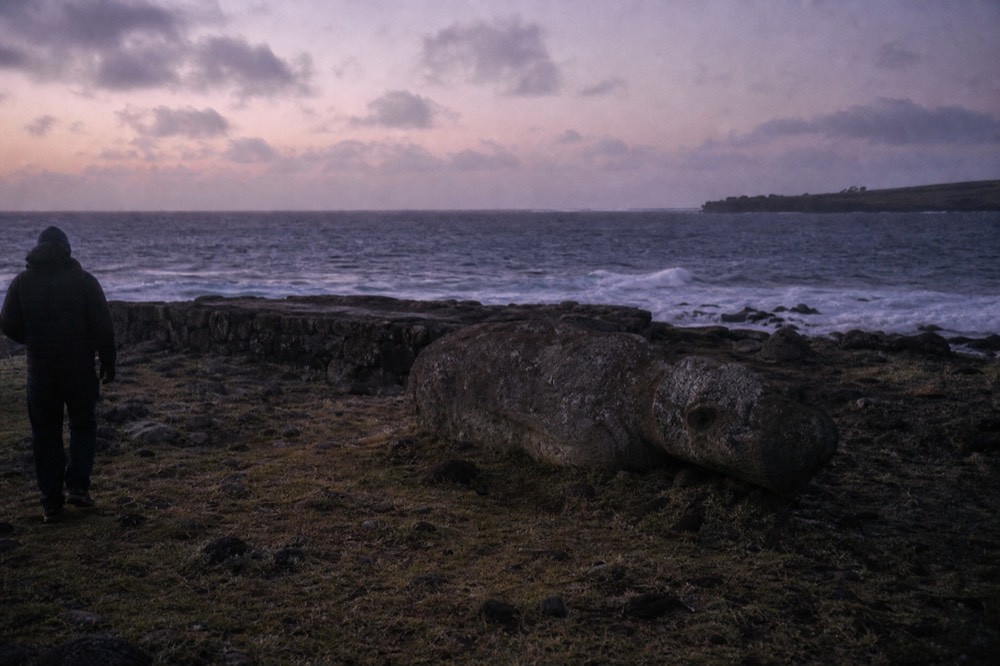
Islanders did, during the conflicts that followed. The park attributes the toppled moai at Akahanga to ancient village life and the civil wars of the 18th century, and Vaihu holds eight fallen statues on one of the longest platforms on the island. Almost every moai standing today was re-erected in the modern era.
Tongariki makes the point better than any explanation. Fifteen moai stand on the largest restored ahu on the island, the tallest of them around nine metres, and they are there because a restoration team backed by Japanese donations put them back in the 1990s after a tsunami had scattered them.
Walk the south coast and the pattern is obvious: face-down statues, intact platforms, topknots rolled away separately. That is not neglect. It is the deliberate un-making of a religious system by the people who built it, and it is the most direct answer available. Nobody was commissioning new ones.
Where can you see the whole argument in one trip?
In two circuits. The south and east day covers the toppled platforms, the quarry and Tongariki. The Rano Kau day covers Orongo and the birdman village that replaced them. An accredited local guide is mandatory inside the park, and the $100 adult ticket covers 10 consecutive days with those two headline sites limited to one visit each.
The order matters more than most itineraries admit. Vaihu and Akahanga first with their statues face down in the grass, then the quarry full of figures that never left, then Tongariki standing restored: that is the sequence in the order it happened. Reverse it and the story arrives backwards.
Budget the ticket separately: no tour includes it, it is bought at the official park site or on arrival, and the price rose from $80 to $100 for foreign adults on 1 October 2025, which half the internet still has not caught up with. The ticket rules in full cover the child rate and the single-entry trap. For the whole island rather than one day of it, see what the two-day package covers across both circuits, or compare every bookable tour on the island first.
The one thing no guide can give you is an ending. The carving stopped, the statues came down, the island kept its people, and the argument over exactly why is still running. Standing on that quarry slope with an unfinished giant at your feet is the closest anyone gets to the evidence itself.