Moai statues: what they are, how they were made, and where to see them
Around a thousand carved ancestors sit on a 63-square-mile island, most of them face down in the grass, and the handful now standing upright are standing because someone put them back.
Short answer
Moai are monolithic ancestor figures carved by the Rapa Nui people from volcanic tuff at the Rano Raraku quarry. Roughly 1,000 survive, with the Easter Island Statue Project having inventoried 1,040 sculptural objects. Most were moved to coastal platforms and set facing inland over their villages. Only about 50 stand upright today; the rest lie fallen or unfinished.
Walk up the outer slope of Rano Raraku and the first thing that registers is not scale. It is repetition. Faces tilt out of the grass at every angle, some upright to the shoulder, some sideways, some staring at the sky, and it takes a moment to understand that this is not a display. It is a workshop that stopped mid-shift and never restarted.
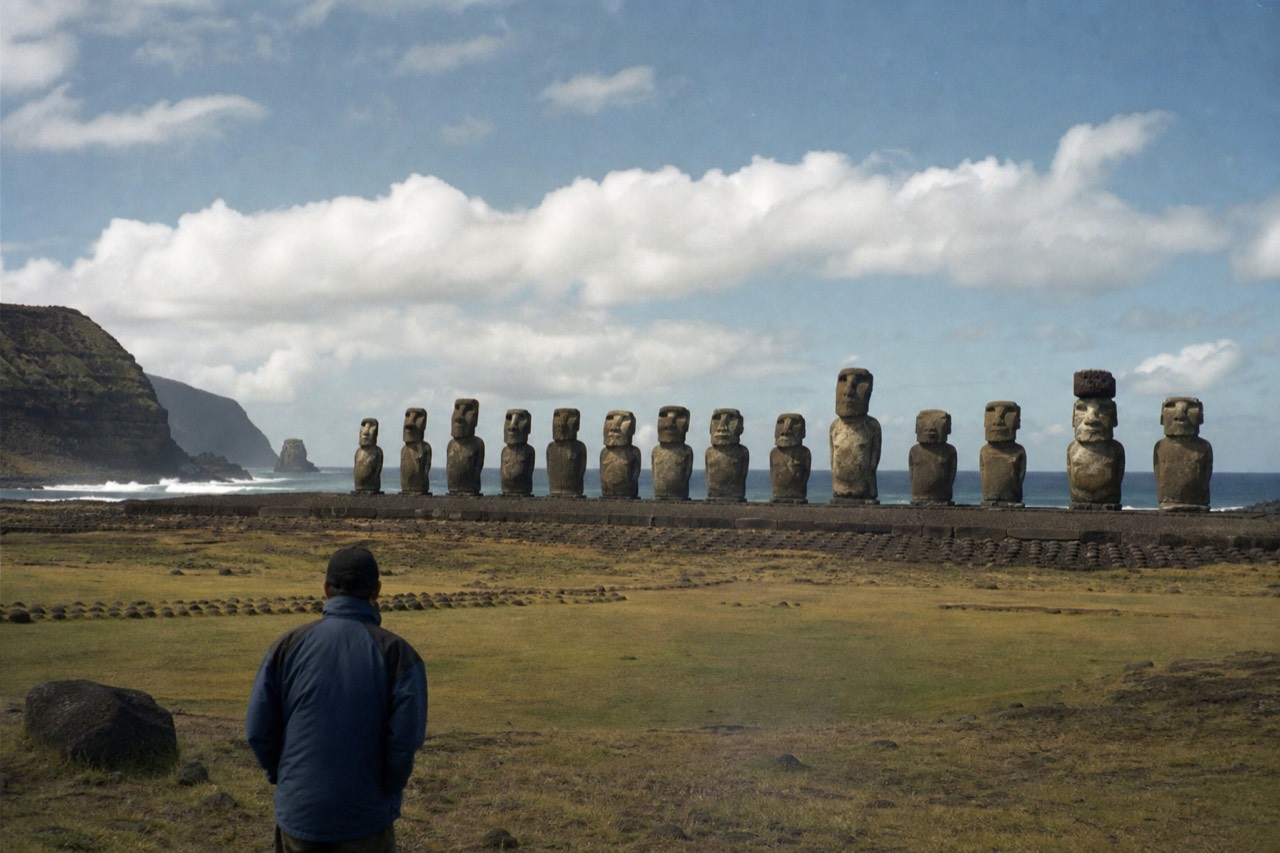
Nearly every statue on Rapa Nui came out of that one hillside. They were cut from compressed volcanic ash, finished on their backs in the rock, broken free, moved as far as the far side of the island, raised onto stone platforms, capped with a red cylinder, and given eyes. Then, over a couple of centuries, almost every single one was pulled down. What visitors photograph today at Ahu Tongariki is a twentieth-century restoration of a fifteenth-century idea.
What are the moai statues?
Moai are monolithic human figures carved by the Rapa Nui people to hold the spirit of important ancestors. They are called aringa ora ata tepuna, the living faces of the ancestors. Most sat on ceremonial platforms called ahu that also served as tombs, facing inland to watch over the village whose dead they represented.
They are ancestors, not gods and not decoration. Each one carried mana, the spiritual authority of the chief or lineage head it stood for, and that authority flowed outward from the statue toward the living people in front of it. That single fact explains most of the design: the oversized head marks the seat of the power, the rigid arms and long fingers laid across the belly close the body off, and the deep brow, jutting chin and rectangular ears are stylized rather than portrait-like, because the point was lineage, not likeness.
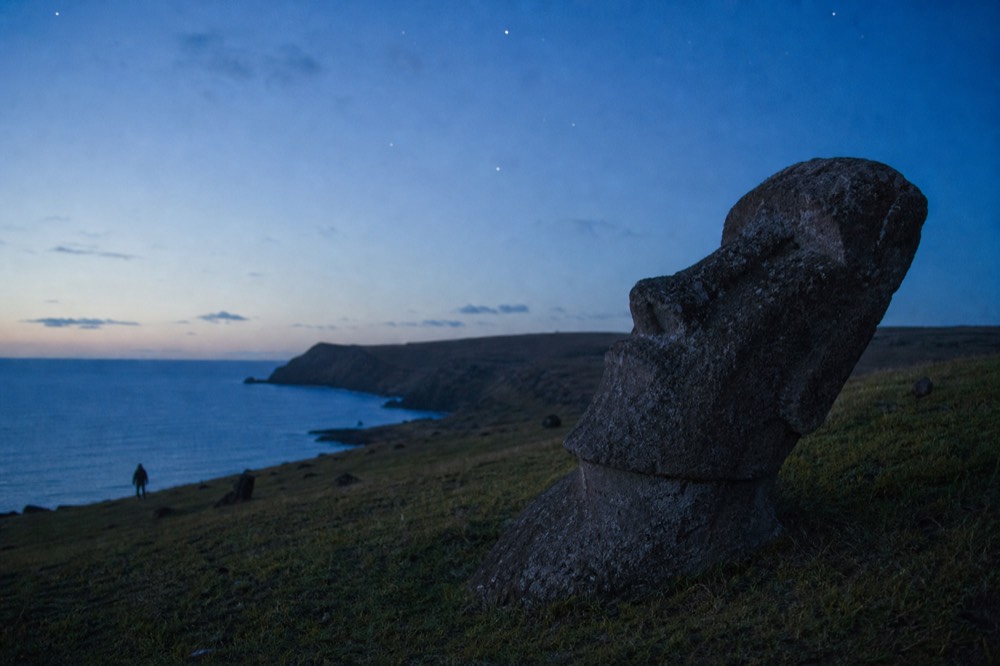
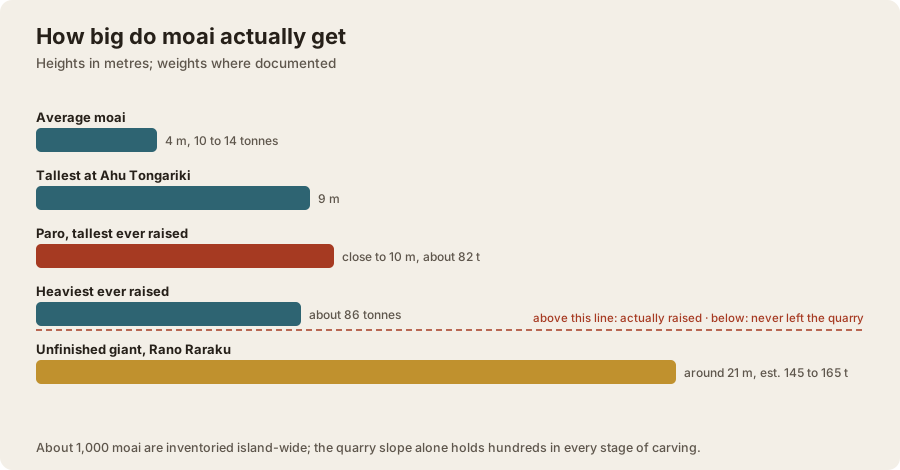
The size range is wider than photographs suggest. An average moai runs about four metres, roughly 13 feet, and weighs between 10 and 14 tonnes. The tallest ever successfully raised, Paro, stands close to 10 metres at about 82 tonnes. The heaviest raised statue is squatter still at roughly 86 tonnes, confirmed by crane during restoration at Ahu Tongariki. Left unfinished in the quarry is a giant of around 21 metres, estimated at 145 to 165 tonnes, which nobody has demonstrated could be moved.
| The numbers that matter | Figure |
|---|---|
| Sculptural objects inventoried by the Easter Island Statue Project | 1,040 |
| Commonly cited count of surviving moai | Roughly 1,000 |
| Documented moai in the standard tally | 887 |
| Remaining at the Rano Raraku quarry | 397 |
| Successfully transported to their ahu | 288 |
| Standing upright again after modern restoration | About 50 |
| Ceremonial ahu platforms island-wide | Around 300 |
| Average height and weight | About 4 m, 10 to 14 tonnes |
| Tallest raised (Paro) | Close to 10 m, about 82 tonnes |
| Heaviest ever raised | About 86 tonnes |
| Largest unfinished, still in the bedrock | Around 21 m, an estimated 145 to 165 tonnes |
Dating is where sources genuinely spread out. Reference works place the carving era between the 13th and 17th centuries, with 1250 to 1500, 1300 to 1700 and 1400 to 1650 all in circulation. That range reflects how few statues have been dated directly against how many were dated by association with a platform, and the platforms were rebuilt repeatedly.
Do the Easter Island heads have bodies?
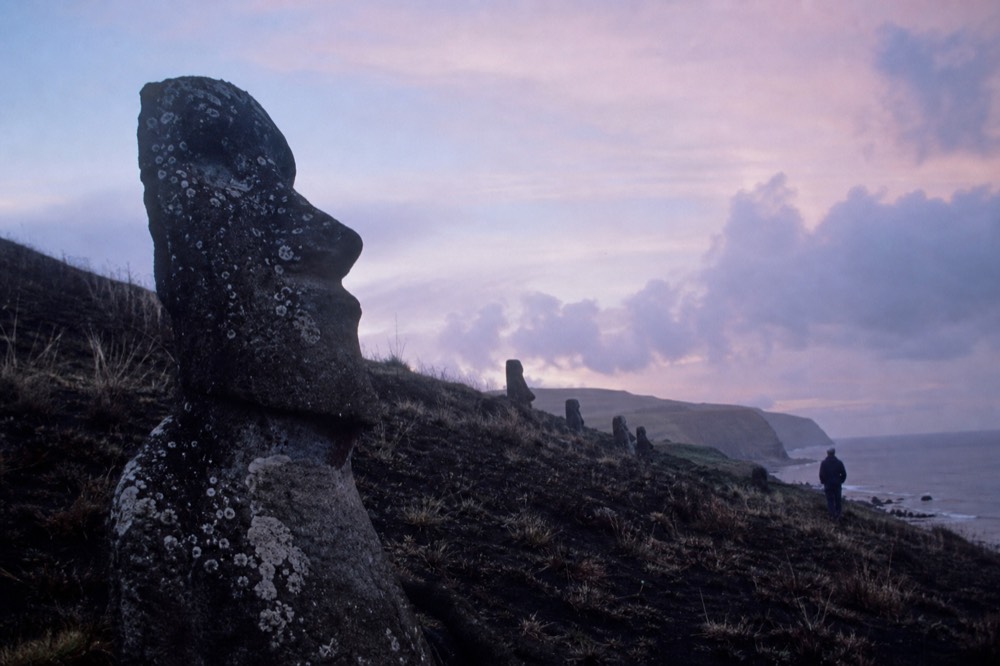
Yes. Almost all of them do. The famous "heads" at Rano Raraku are full figures with torsos, arms and hands, buried up to the shoulders or neck by centuries of sediment washing down the quarry slope. Excavation at the quarry has exposed complete bodies, some carved with designs on the back, below statues that looked like heads for generations.
This is the most persistent misunderstanding about Rapa Nui, and it comes from a photographic accident. The statues in every travel article are the ones on the quarry's outer slope, which are precisely the ones that have been silting up for five hundred years. Every image of a lone stone head on a green hill is a picture of a buried body.
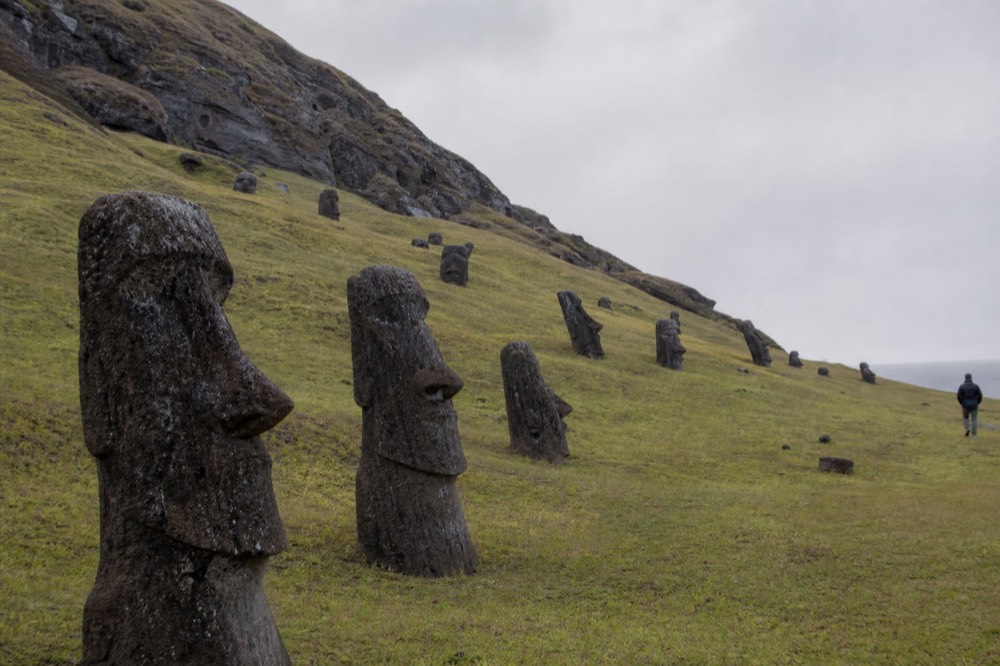
The bodies matter for more than trivia. Excavated torsos carry carved motifs on the back, including designs read as birdman imagery that may have been added long after the statue was raised, which tells you these were living objects that got reworked rather than monuments that got forgotten. Statues on coastal platforms were never buried, so at Ahu Tongariki or Ahu Nau Nau you see what a completed moai always looked like: a full standing figure, hands meeting at the front, feet defined at the base.
Many quarry statues are also still leaning at the angle at which they were parked, set into pits so the sculptors could finish the back, and they were never meant to be seen that way. The hillside is unfinished inventory rather than an arrangement, which is the difference between a gallery and a factory floor.
If you want the full arithmetic of what is buried, what is standing and what nobody can agree on, the count question has its own honest answer.
How were the moai carved at Rano Raraku?
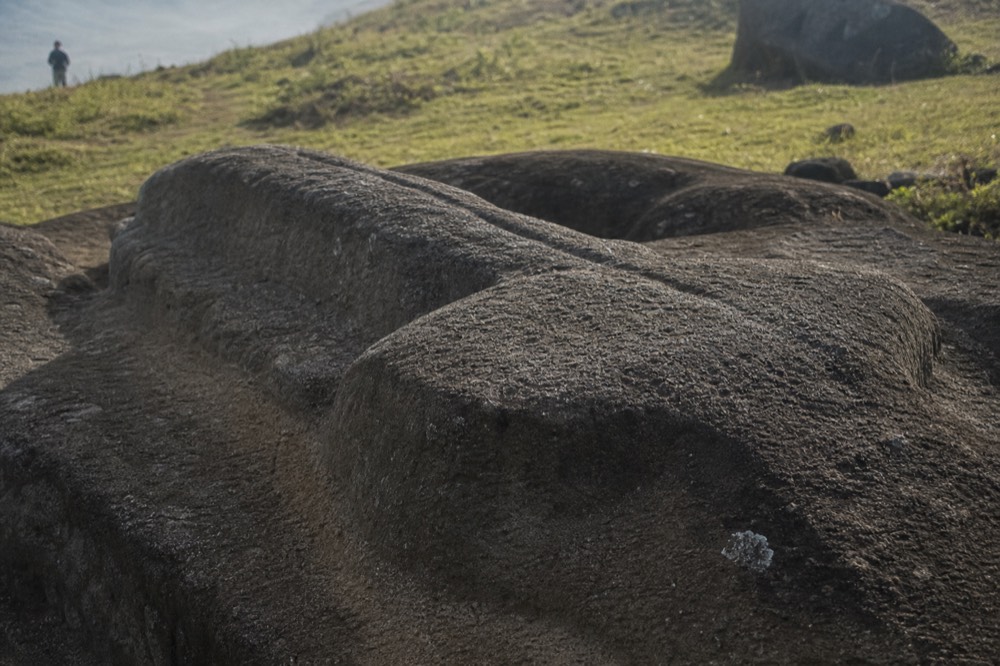
Almost all of them were cut directly out of the bedrock of one extinct crater. Around 95 percent of all moai originate at Rano Raraku, where sculptors used hand-held basalt picks called toki to hollow a trench around a figure lying on its back, finish the front and sides in place, then snap the keel that held it to the rock.
Rano Raraku is a tuff cone, and tuff is compacted volcanic ash: soft enough to shape with stone tools, hard enough to hold a face for centuries. That combination made industrial-scale sculpture possible on an island with no metal, and the same softness is why the statues erode and why nobody may lay a hand on them now.
| Stage | Where it happened | What it involved | What survives to see today |
|---|---|---|---|
| Blocking out | Rano Raraku quarry face | Cutting a trench around a figure lying on its back in the bedrock | Dozens of unfinished figures still attached, including the 21 m giant |
| Front and side finishing | Same niche | Face, ears, arms and hands carved while the statue was still joined to the rock by a keel along its spine | Half-worked statues with visible tool channels around them |
| Detachment | Quarry slope | Breaking the keel and easing the figure down the hill | Statues parked in pits, buried to the shoulders by later sediment |
| Back carving and base squaring | Quarry pits | Finishing the back, defining the base flat enough to stand on | Excavated torsos with carved designs on the reverse |
| Transport | The moai roads | Moving the figure to its coastal platform, most likely upright | Statues abandoned face down and face up along the old routes |
| Raising and finishing | The ahu | Levering the statue upright, adding the pukao, setting the eyes | Restored platforms where a complete moai can be read at full height |
The workshop never closed on its own terms. Statues sit at every point in that pipeline, which is why the quarry does more explanatory work than any restored platform can. A 2025 study in PLOS One examined production at Rano Raraku directly, and survey work by the Easter Island Statue Project continues to log and analyse the inventory, while the quarry's site history is summarized in the standard Rano Raraku reference.
One practical warning that catches people out. Rano Raraku is a single-entry site: your park ticket admits you once and once only, the same rule that applies at Orongo. You cannot wander in for an hour, leave, and come back after lunch. How the park ticket actually works covers the rest of that rule set, and it is the reason most visitors put the quarry on a guided full day rather than an improvised morning.
How did the moai get from the quarry to the coast?
By walking, according to Rapa Nui oral tradition and to the archaeological experiments that back it. Teams used ropes tied to the head to rock a statue side to side, pivoting it forward on the rounded edge of its base. A 2025 study measured 62 statues abandoned on the transport roads with drones and physics modelling and found base and cross-section shapes consistent with upright movement.
The Rapa Nui account has always been direct: the moai walked. For most of the twentieth century that was treated as poetry rather than method, while log-roller and sled models dominated. The upright-rocking hypothesis now has the stronger evidential footing, partly because it explains details that rollers do not.
Those details sit in the statues themselves. Transport-road moai have a base that is not flat but subtly curved and a forward-leaning centre of mass, both of which make a rocking gait efficient and make a horizontal drag awkward. The 2025 drone and physics work quantified exactly this across a large sample of road statues rather than a single reconstruction, which is why it moved the argument along.
Then there is the fallout evidence. Statues lie beside the old routes in both directions, some face down, some on their backs, and a walking model predicts exactly that: a figure that tips forward lands on its face, a figure that tips backward does not. A sled model predicts neither pattern well. None of this closes the transport question, and reputable archaeologists still argue for hybrid methods over different terrain. What has changed is that the islanders' own explanation is now the leading one rather than the charming one.
The far coastal platforms sit kilometres from the quarry across broken volcanic ground, which is why the abandoned road statues are the most quietly impressive things on the island. A guided day is the only lawful way to reach most of them, since park sites require a Ma'u Henua-accredited local guide. Anyone building a route around the quarry and the roads should look at which moai-focused itineraries are running on their dates, because the history-heavy days fill differently from the general sightseeing ones.
Why do the moai face inland?
Because they were watching over people, not the ocean. A moai looked out from its platform toward the village and the land its lineage held, with its back to the sea. The famous exception is Ahu Akivi, an inland platform where seven statues appear to face the water, and even there the accepted reading is that they still face their own settlement, which lay between them and the coast.
Almost every restored platform on the island reads the same way once you know what to look for. Stand behind an ahu with the surf at your back and you are standing where nobody was supposed to stand. Stand in front of it, on the cleared ceremonial ground, and the statues are looking at you. That ground, the plaza, was as much a part of the monument as the stone.
Ahu Akivi attracts more speculation than any other site because of that apparent seaward gaze, and a popular story frames the seven as navigators looking home across the Pacific. The archaeological reading is more grounded: Akivi sits well inland, its village lay downslope toward the sea, and the statues face it in the ordinary way. The unusual thing about Akivi is not the direction. It is that a major platform was built away from the coast at all.
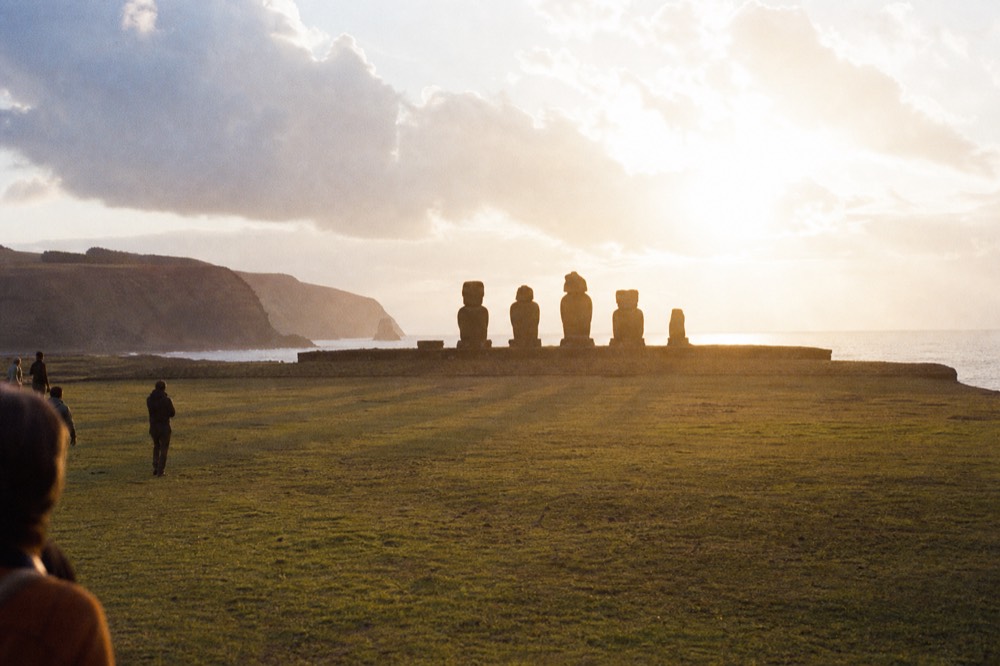
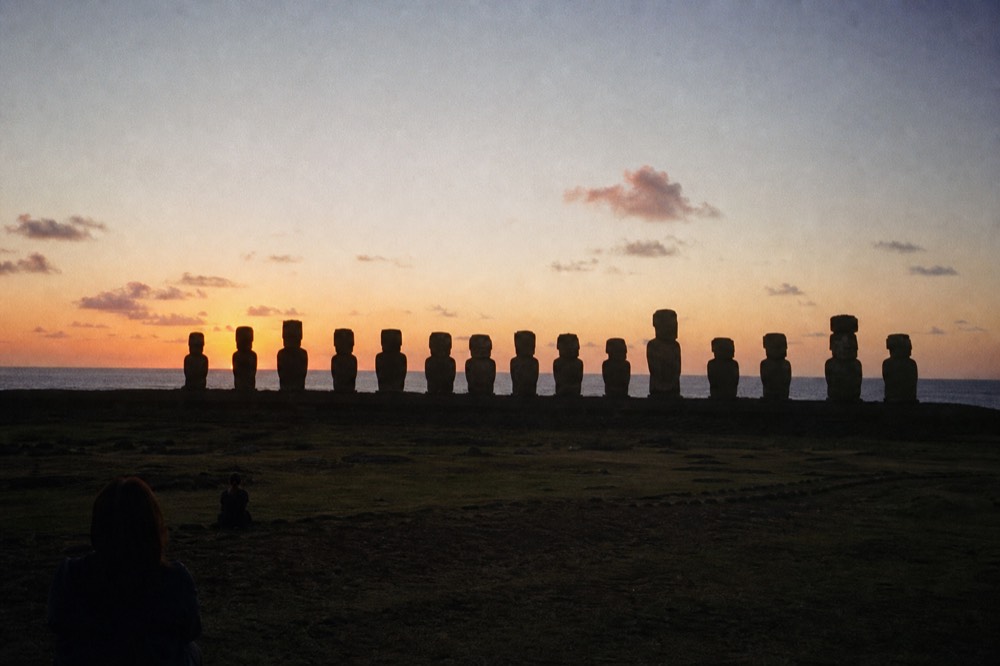
Orientation also had a practical consequence that visitors feel immediately. Because moai face inland, the classic photograph of statues silhouetted against the ocean is a photograph of their backs, and the classic photograph of their faces has the land behind them. At Ahu Tongariki, where the platform runs along the south coast, that geometry is what makes the dawn shoot work: the sun comes up behind the statues and rims fifteen silhouettes at once. The sunrise timing and how sessions are run covers the early-hours side of that, since the site opens at 6:00 for dawn visitors.
What are the red hats on the moai?
They are pukao, cylinders of red scoria quarried at Puna Pau, a separate small crater from the one that produced the statues. A pukao represents hair gathered and tied in a topknot, and it marked status. Only some moai ever received one, and most that did have lost it, which is why the red cylinders now lie scattered around platforms rather than sitting on heads.
Two quarries, two rocks, two colours. Rano Raraku gave the grey-brown tuff of the bodies. Puna Pau gave a soft, deep-red scoria that carved easily into rounded drums and reads from a distance as a completely different material, which was clearly the intention. Getting a multi-tonne cylinder onto a head that already stood several metres up was a second engineering problem after the first one had been solved.
| Element | Material and source | What it signalled | Where you can still see it |
|---|---|---|---|
| Body | Volcanic tuff, Rano Raraku | The ancestor figure itself | Everywhere, in every state of completion |
| Pukao | Red scoria, Puna Pau | High status, hair tied in a topknot | Restored on the statues at Anakena's Ahu Nau Nau; loose drums at Puna Pau |
| Eyes | White coral with dark inlaid iris | The moment the statue became "alive" and its mana switched on | Reconstructed examples in museum display; empty sockets on site |
| Ahu platform | Fitted local basalt slabs | Tomb and ceremonial stage for the lineage | Around 300 platforms island-wide, most ruined |
| Plaza | Cleared ground in front of the ahu | Where the living stood to receive the ancestor's mana | Visible as the open ground in front of every restored platform |
The eyes are the detail that changes how the statues feel. A moai on its platform without eyes was, in Rapa Nui understanding, not yet switched on. Setting white coral into the socket with a dark inlaid iris was the final act, and it turned an object into an ancestor with a functioning gaze. Every statue you see on the island today has empty sockets, which means every statue you see is, in the original terms, dormant.
Anakena is where all three elements come together in one frame: restored moai, red pukao back on their heads, and behind them a stand of palms that was planted in 1960 rather than surviving from antiquity. It is the most photographed beach on Rapa Nui for good reason, and it appears on most full-day circuits. Travellers building a day around the north coast can check what the full-day circuit costs on their dates and see whether Anakena sits in the afternoon slot, which is when the light is best on the pukao.
Why are so many moai lying face down?
Because they were pulled down deliberately. Across the 18th and 19th centuries, during a period of inter-clan conflict and social upheaval, the statues were toppled from their platforms, most of them onto their faces. By the second half of the 19th century essentially none were left standing. Every upright moai on Rapa Nui today was re-erected in modern times.
The sequence is often skipped in travel writing. European visitors in the 18th century recorded statues still standing on their ahu, later visitors recorded fewer, and accounts by the 1860s describe an island of fallen monuments. Sources give different end dates, with 1722 and 1868 both appearing as markers, but the direction of travel is not in dispute.
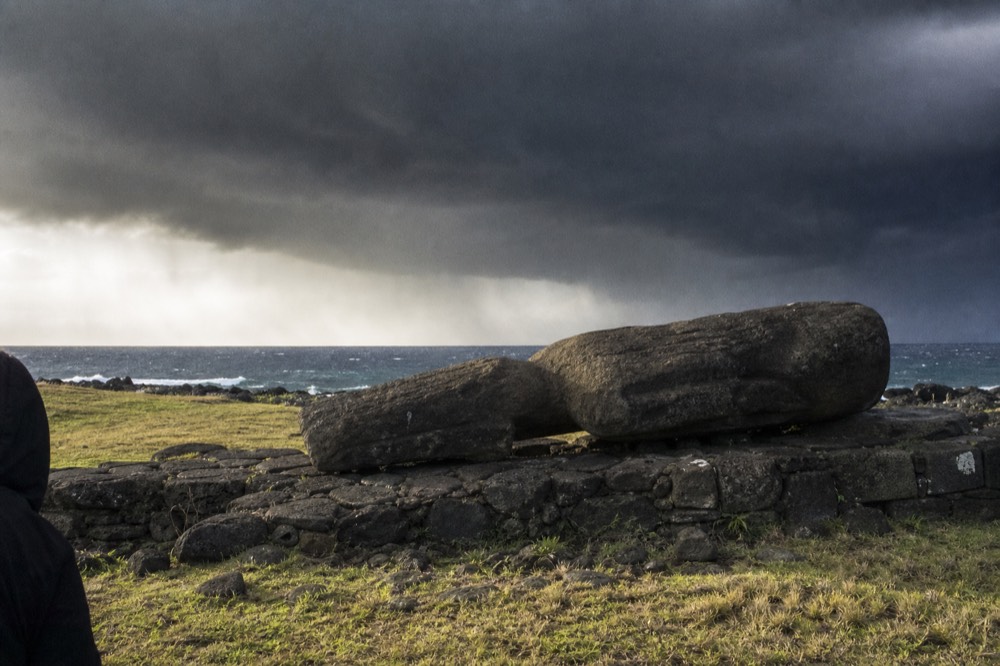
Toppling was not vandalism in the modern sense. Knocking an ancestor off its platform removed its mana from a rival lineage, which made the statues political targets rather than art. Many were dropped in a way that broke the neck, a hard thing to do by accident, and that is why so many restorations are only partial.
| Restoration milestone | What happened |
|---|---|
| Toppling era, 18th to 19th century | Statues pulled from their platforms during inter-clan conflict; by the later 1800s none remained standing |
| Mid-20th century onward | International conservation involvement begins, with the World Monuments Fund active on moai and ceremonial sites since the 1960s |
| 1990s, Ahu Tongariki | The island's largest platform rebuilt and its 15 moai re-erected with Japanese funding and a Japanese team, after a tsunami had scattered them inland |
| Present day | About 50 statues stand upright island-wide, out of roughly 1,000 |
| 2022 | October wildfire burns across the Rano Raraku quarry |
| 2023 | UNESCO Heritage Emergency Fund supports assessment work, around 97,000 dollars, plus a risk management plan |
| May 2025 | Ma'u Henua begins hands-on conservation of five of the worst fire-damaged moai |
| 2025 to 2026 | Monitoring continues; a November 2025 paper analyses the fire damage; the World Monuments Fund confirms further committed funding in its 2026 announcements |
Tongariki deserves its own paragraph. The platform is the largest on the island and carries 15 statues, the tallest around 9 metres, and before the 1990s it was a debris field, its moai having been swept inland by a tsunami on top of the earlier toppling. The rebuild, funded from Japan and executed with a crane, is the reason the island's most recognised view exists at all. The 86-tonne figure for the heaviest raised moai comes from that crane work.
What did the 2022 Rano Raraku fire actually damage?
A wildfire crossed the quarry in October 2022 and charred or cracked statues across the slope. Preliminary counts put the number of affected moai at around 80, with other reports citing figures near 100 and around 22 showing significant damage. Later analysis found heat effects reaching up to 10 centimetres below the stone surface. Access to the quarry has been restored; the scarring is visible.
Tuff behaves badly in fire. Moisture inside the stone flashes to steam and spalls the surface, soot bonds into the pores, and the heat opens micro-fractures that keep working long after the flames are out. That last point is why the 10-centimetre subsurface finding mattered more than the blackening: a statue can look merely dirty and still be structurally compromised.
The response has been slow and deliberate rather than dramatic. UNESCO's Heritage Emergency Fund backed an assessment and a risk management plan in 2023. Physical conservation began in May 2025, led by the Ma'u Henua community with restorers from the University of Florence, working on five of the worst-affected statues with a sequence of treatments: soot removal, lichen control, consolidation of the weakened stone, then a water-repellent layer. That work and the wider climate pressure on the monuments are covered in the reporting on the island's own restorers.
The fire also produced an odd side effect. A previously unrecorded moai of about 1.6 metres was exposed in the aftermath, in ground left bare by the burn and by a lack of rain, and new small statues have turned up in dried lake beds as recently as 2025. The island is still, in a literal sense, revealing statues. That is one reason no count is ever final, and it feeds directly into the fragility argument behind the no-touching rule, which the question of why you cannot touch a moai sets out in full.
Where do you see which kind of moai?
Each major site shows a different stage of the same story. Rano Raraku is unfinished production. Tongariki is a full restored platform of 15. Ahu Akivi is the inland seven. Anakena has pukao back on heads. Ahu Te Pito Kura holds Paro, the tallest ever raised, still lying where it fell. Tahai is the one cluster near town you can reach without a guided park visit.
| Site | What you actually see | Why go |
|---|---|---|
| Rano Raraku | The quarry: statues at every stage, dozens buried to the shoulders, the 21 m giant still in the rock | The only place the whole production process is legible. Single-entry on your ticket |
| Ahu Tongariki | 15 moai on the island's largest platform, tallest about 9 m | The signature view, and the site that opens at 6:00 for dawn visitors |
| Ahu Akivi | Seven inland statues that appear to look toward the sea | The orientation exception, and the quietest major platform |
| Anakena, Ahu Nau Nau | Restored moai with red pukao, backed by palms planted in 1960 | The only place to read a "complete" moai beside a swimmable beach |
| Ahu Te Pito Kura | Paro, close to 10 m and about 82 tonnes, fallen | Scale you cannot get from an upright statue at a polite distance |
| Puna Pau | The scoria crater where the pukao were cut, with drums still lying loose | Explains the red cylinders better than any caption at a platform |
| The moai roads | Statues abandoned in transit, face up and face down | The transport argument, on the ground |
| Ahu Tahai, by Hanga Roa | A restored cluster including one moai with its eyes reconstructed | Reachable on foot from town, and the standard sunset spot |
Geography decides how you build a day. Rano Raraku and Tongariki sit close together on the southeast side, so they are almost always paired with the quarry first. Anakena is north and works as an afternoon stop with time to swim. Ahu Akivi and Puna Pau sit inland and often get folded into a second half-day rather than the main circuit, which is why the standard product here is a full-day loop rather than a series of short outings.
Tahai is the useful outlier. It sits within walking distance of Hanga Roa, outside the sites that require an accredited guide, which makes it the place to go on an arrival evening before the park part of the trip begins. What else fills the days beyond the statues covers the non-moai half of the island, and a workable day-by-day shape for a trip puts the circuits in an order that does not double back.
Anyone who wants the archaeology explained slowly rather than at group pace should compare what a private archaeology day costs against the standard circuit. And for the dawn version of Tongariki, where the fifteen come up as silhouettes before the sun clears the horizon, see which sunrise departures still have space. Both sit alongside every bookable tour on the island and the full set of single-day circuits.
What do people get wrong about the moai?
Four things, repeatedly: that they are heads, that the transport method is unknown, that a mysterious collapse wiped out the carvers, and that the statues standing today have always been standing. All four have better answers now than they did twenty years ago, and the better answers are more interesting than the myths.
| The claim | What the evidence actually says |
|---|---|
| "They are giant heads" | Almost all have full bodies. The quarry statues are buried to the shoulders by sediment, and excavated torsos carry carved designs on the back |
| "Nobody knows how they were moved" | Rapa Nui oral tradition says they walked, and a 2025 drone and physics study of 62 road statues found base and cross-section shapes consistent with upright rocking transport |
| "The island destroyed itself in an ecological collapse" | A 2024 ancient DNA study found no evidence supporting the societal collapse narrative that dominated popular accounts |
| "The statues you photograph have stood for 500 years" | Every upright moai was re-erected in modern times. Tongariki's 15 went back up in the 1990s after a tsunami had scattered them |
| "The writing system came from Europeans" | Radiocarbon dating published in 2024 places one rongorongo inscription at roughly 1493 to 1509, before contact |
| "Ahu Akivi's seven face the sea because they were navigators" | They face the site of their own village, which lay between the platform and the water. The unusual thing is the inland location, not the direction |
The collapse question is the one that has shifted most. For decades the island was used as a parable about self-inflicted environmental ruin, and that framing shaped almost every documentary made about it. The 2024 ancient DNA work found no genetic signal of the population crash that story requires. Deforestation still happened; the tidy morality tale attached to it is what does not survive contact with the data. Why the carving stopped is the better-posed question, and it has a more honest answer.
A guided day that starts at the quarry and ends at a restored platform tells all of this in the right order, because the quarry explains the platform and no platform explains the quarry. The island's UNESCO inscription covers the whole archaeological landscape rather than individual monuments, as the World Heritage listing for Rapa Nui National Park sets out.
Common questions
What does the word moai mean?
It is the Rapa Nui word for the statues themselves. The fuller traditional phrase is aringa ora ata tepuna, the living faces of the ancestors, which is closer to what the objects were understood to be: a physical seat for the mana of a lineage's important dead, rather than a portrait or a god.
How old are the moai?
Reference works place the carving era between the 13th and 17th centuries, with ranges such as 1250 to 1500, 1300 to 1700 and 1400 to 1650 all in use. The spread reflects how few statues have been dated directly, since most are dated by association with platforms that were rebuilt more than once.
Can you go inside the Rano Raraku quarry on your own?
No. Park sites require entry with a Ma'u Henua-accredited local guide, and Rano Raraku is additionally limited to a single entry per park ticket, as is Orongo. Hanga Roa town, the Tahai area and Anakena beach itself are the practical places people move around independently.
Are new moai still being found?
Yes. A previously unrecorded statue of about 1.6 metres was exposed after the 2022 fire and a dry spell left ground bare, and further small statues have been reported in dried lake beds as recently as 2025. That is one reason no published count of the moai should be treated as final.
Which single site is worth prioritising if time is short?
Rano Raraku, because it explains everything else. A restored platform shows you a finished statue but tells you nothing about how it got there, while the quarry shows the whole sequence from bedrock to abandoned transport. Most full-day circuits pair it with Ahu Tongariki, which sits nearby on the southeast coast.