How many moai are on Easter Island?
Roughly 1,000, and the Easter Island Statue Project logs 1,040. Here is why the quarry count alone swings between 397 and 887 depending on who is counting.
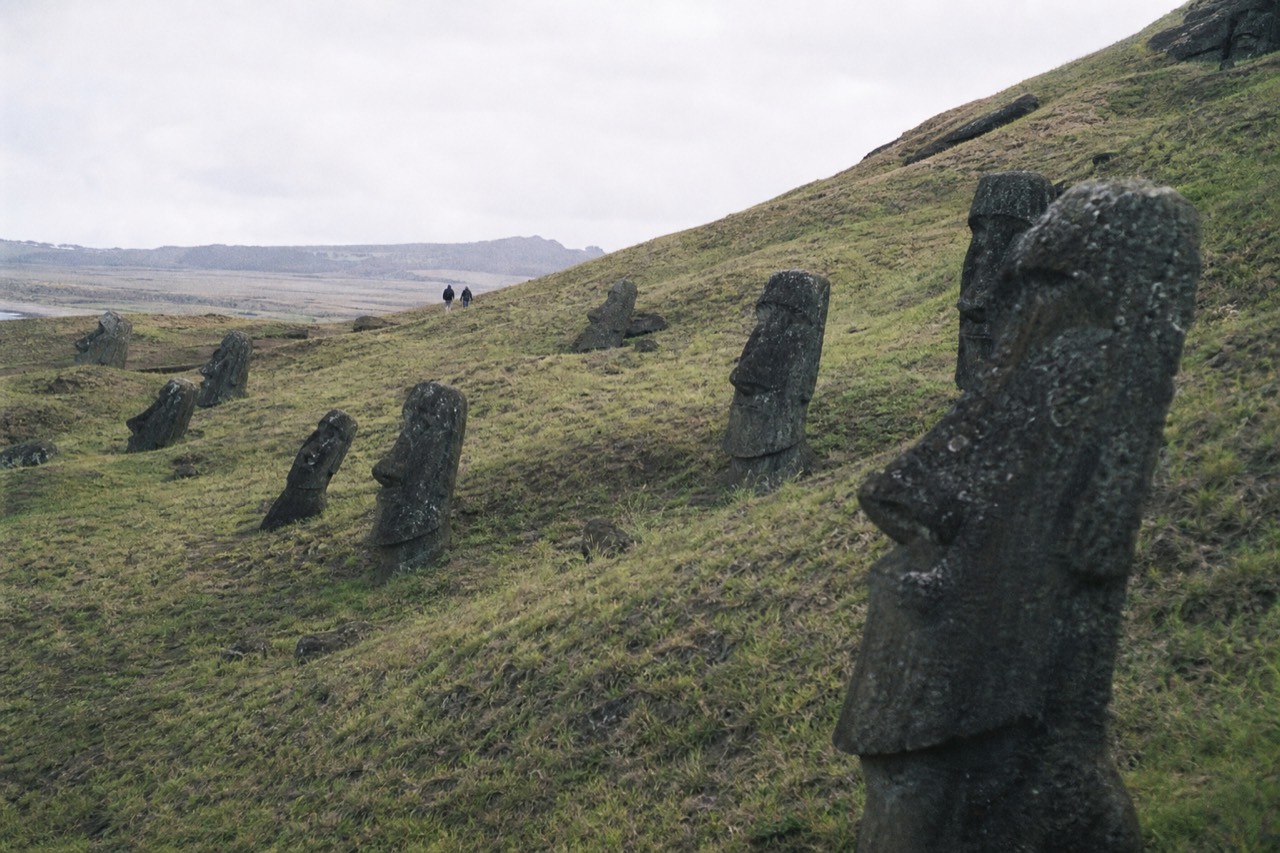
Ask three sources how many moai there are and you get a thousand, 1,040 and 887. Ask how many are at the quarry and you get 397 from one and 887 from another, the same number just used for the whole island. None of this is sloppiness. It is what happens when a count depends on a definition nobody has ever agreed on.
The short version is that roughly a thousand carved figures survive on a 63-square-mile island, most of them not standing, many of them buried to the shoulders, and at least a few of them still undiscovered. That last part is not hypothetical. New statues have surfaced as recently as 2025.
So what is the real number of moai?
Around 1,000. The most systematic accounting, by the Easter Island Statue Project, has inventoried and analysed 1,040 monolithic sculptural objects. The standard archaeological tally most reference works reach for is 887 documented moai. Reporting in 2026 described more than 1,000 as logged. All three are defensible; they are counting slightly different things.
The spread between 887 and 1,040 is not error bars on a measurement. It is the gap between "moai formally documented as moai" and "monolithic sculptural objects catalogued in a survey", and the second category is deliberately wider: it picks up fragments, heads separated from bodies, unfinished blocks clearly on their way to becoming statues, and figures too damaged to classify confidently.
| The figure | What it counts | Where it comes from |
|---|---|---|
| 1,040 | Monolithic sculptural objects inventoried and analysed | The Easter Island Statue Project's survey work |
| "More than 1,000" | Statues logged, in 2026 reporting on new discoveries | Press coverage of ongoing survey and discovery |
| "Nearly 1,000" | The general figure used by UNESCO-adjacent and encyclopedic sources | The consensus round number |
| 887 | Documented moai in the standard archaeological tally | The most-cited breakdown, also quoted by some sources as the quarry total |
| 397 | Moai remaining at the Rano Raraku quarry | The classic three-way split of the 887 |
| 288 | Moai successfully transported to their final ahu | Same breakdown |
| About 50 | Statues standing upright today | Modern restoration record |
| Around 300 | Ceremonial ahu platforms island-wide | Park and UNESCO estimates |
Two rows in that table deserve a flag. The 887 appears twice in the literature: as the island-wide documented total, and, in at least one widely read reference, as the number remaining at Rano Raraku specifically. Those cannot both be right, and the collision is the single best illustration of why moai counting is messy. The project's own survey record is published at the Easter Island Statue Project, and the quarry's figures are summarised in the standard Rano Raraku reference.
Why do the counts disagree so badly?
Four reasons: definitions, burial, incompleteness and discovery. A count has to decide whether a fragment is a moai, whether an unfinished block still in the bedrock counts, whether a buried torso that nobody has excavated counts, and whether to include statues found after the last survey closed. Different projects answer differently and get different totals.
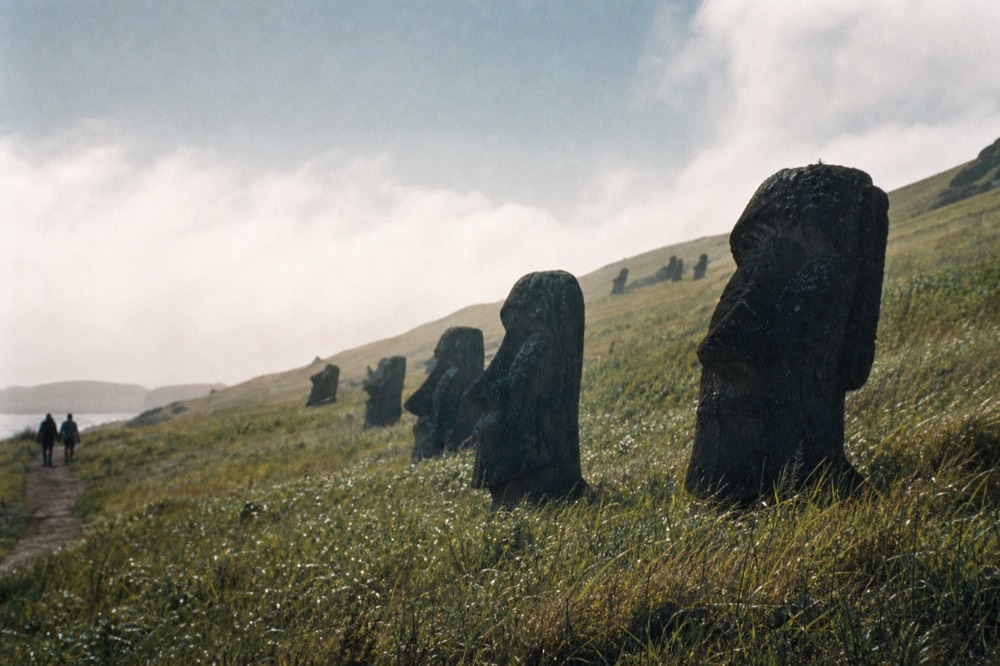
Burial is the largest single complication. The statues that made Rapa Nui famous, the "heads" on the quarry slope, are full figures silted up to the shoulders over centuries. Excavation at Rano Raraku has exposed complete bodies with carved designs on the back beneath statues that had looked like heads for generations. A survey that counts what is visible and a survey that counts what is there will never match.
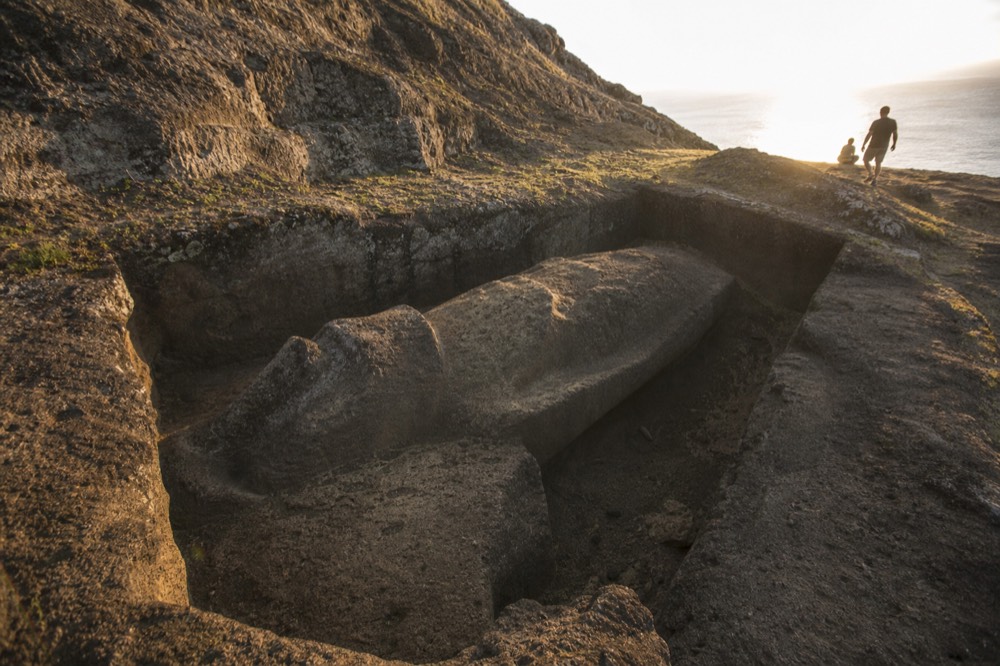
Incompleteness cuts the other way. Rano Raraku holds figures at every stage from a rough outline cut into the rock to a finished statue waiting to be moved, including a giant of around 21 metres still attached to the bedrock. Whether a half-carved block counts is a judgement call that moves the quarry number substantially.
Then the island keeps producing new ones. A previously unrecorded moai of about 1.6 metres was exposed after the 2022 quarry fire and a dry spell left ground bare, and further small statues have been reported in dried lake beds as recently as 2025. Any published total is a snapshot of a survey, not a closed ledger.
How many moai are still at the quarry?
In the classic breakdown, 397 of the 887 documented moai never left Rano Raraku, which is close to half. Around 95 percent of all moai originated at that one crater, and a 2020 dataset recorded 809 archaeological remains at the quarry of which about 59.7 percent were moai. One reference instead gives 887 as the quarry figure itself, which is the disagreement at the centre of this whole question.
Standing on the outer slope, the higher numbers feel more plausible than the lower ones. Faces appear at every angle across the hillside, each with a body under the grass. The quarry is not a display of leftovers. It is the entire production line, frozen.
The quarry is also single-entry on a park ticket, as is Orongo, so this is a place you see once per visit. That constrains how you plan a day, and how the park ticket and its entry rules work covers the rest of it.
How many moai are standing upright today?
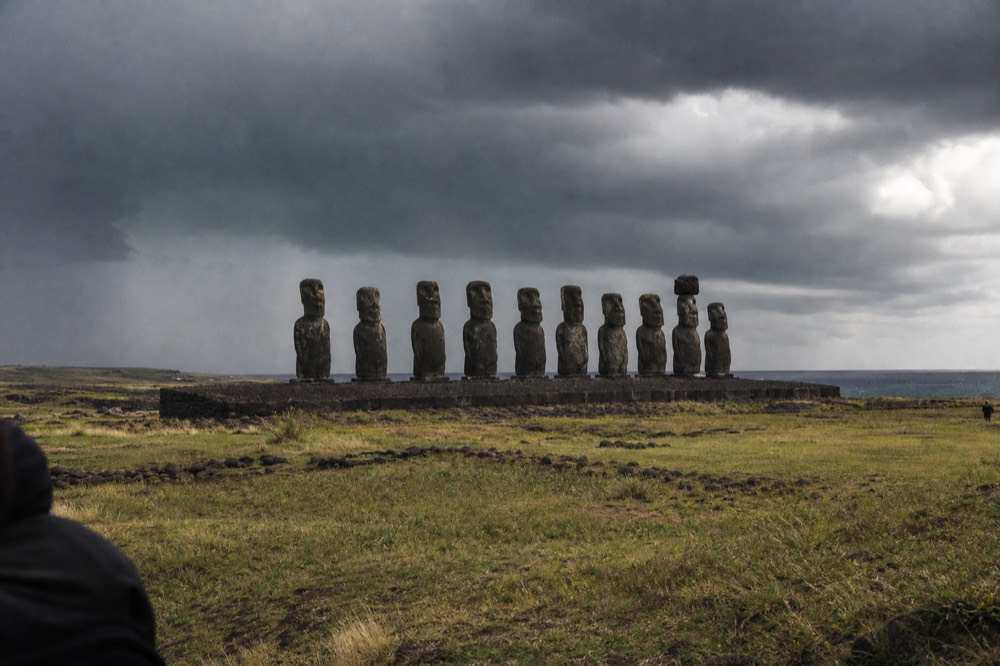
About 50, out of roughly 1,000. Every single one of them was re-erected in modern times. The statues were pulled from their platforms during a period of inter-clan conflict across the 18th and 19th centuries, and by the later 1800s essentially none were left standing. The 15 at Ahu Tongariki went back up in the 1990s.
That ratio is the most under-reported number in any article about Rapa Nui. The overwhelming majority of surviving statues are lying down, buried, unfinished or broken. The photograph everyone has seen, of moai standing in a row against the sky, shows a small fraction of them, and shows twentieth-century restoration work rather than an unbroken five-hundred-year vigil.
| Where the moai are now | Roughly how many | State |
|---|---|---|
| Rano Raraku quarry | 397 in the classic breakdown, close to half the documented total | Unfinished, parked in pits, or buried to the shoulders |
| Transported to their ahu | 288 | Most toppled from their platforms, many with broken necks |
| Standing upright after restoration | About 50 | All re-erected in modern times, including Tongariki's 15 |
| Ahu Tongariki | 15 | The island's largest platform, rebuilt in the 1990s after a tsunami scattered the statues |
| Ahu Akivi | 7 | Inland platform, the famous orientation exception |
| Abandoned along the transport roads | Not separately fixed in the standard breakdown | Face up and face down beside the old routes |
| Newly exposed since 2022 | At least one at about 1.6 m, plus dried lake bed finds reported in 2025 | Uncatalogued when found |
Tongariki is an outlier rather than a norm. Before the 1990s the platform was a debris field: its statues toppled, then swept inland by a tsunami. The rebuild, funded from Japan and carried out with a crane, is the only reason the island's signature view exists, and the heaviest raised moai on record, roughly 86 tonnes, was weighed during that operation.
Where do the published numbers actually come from?
From survey projects, excavation datasets and site references, each with a different scope. The Easter Island Statue Project runs the largest inventory. Excavation at the quarry produced the 2020 dataset of 809 remains. A 2025 paper in PLOS One examined moai production at Rano Raraku directly. Encyclopedic sources compile from all of it, which is where the collisions creep in.
Nobody has ever run a single island-wide census with an agreed definition and published the result as the number. What exists is decades of overlapping fieldwork, each project counting what its own research question required, and a popular literature that quotes whichever figure suits the sentence.
The one thing the sources agree on is the shape of the distribution: most moai are at or near the quarry, a minority made it to a platform, and a small fraction of that minority stands today. That shape is stable across every count, which makes it more useful than any single number. The full moai explainer walks the carving, transport and toppling sequence that produces it, and why the carving stopped covers the end of the production line. The island's protected status, which covers the whole archaeological landscape rather than a list of monuments, is set out in the World Heritage listing for Rapa Nui National Park.
How many moai will you actually see?
Realistically, several hundred in a single day, because one site holds most of them. A standard full-day circuit takes in the quarry slope, where figures are visible in every direction, then Ahu Tongariki's 15, then usually Anakena's restored statues with their red pukao back on. Add Ahu Akivi's seven and you have covered the majority of everything upright on the island.
The arithmetic of a visit is satisfying. Fifteen at Tongariki plus seven at Akivi is 22 of the roughly 50 standing statues on Rapa Nui, in two stops. Everything else that day is lying down, buried or unfinished, which turns the quarry from a curiosity into the main event.
Getting the order right matters more than the itinerary length. Rano Raraku explains every platform you visit afterwards, and no platform explains the quarry, which is why the well-run circuits front-load it. Travellers who want the archaeology paced properly rather than ticked off should compare what a small-group full day costs on their dates, while the standard circuit is worth checking too: see what the flagship full-day route costs on your dates.
Two days is where the count really opens up, because the second circuit reaches the inland and north-coast sites that a single loop skips. Anyone with the time should look at how the two-day package splits the island, and a workable day-by-day shape for the trip sets out which sites belong on which day. Whatever you book, the rope lines apply at all of them, and why nobody is allowed to touch a moai explains what sits behind that.