How to get to Easter Island in 2026: the one flight that matters
Every visitor arrives the same way, on the same airline, out of the same airport, which makes this the rare long-haul trip where the hardest decision is a date rather than a route.
Short answer
LATAM is the only airline serving Easter Island, on a single route from Santiago that takes about five and a half hours and runs five or more times a week on Boeing 787s. Round-trip fares in 2026 usually land between $342 and $504, with peak spikes past $650. Booking roughly ten weeks out is the sweet spot.
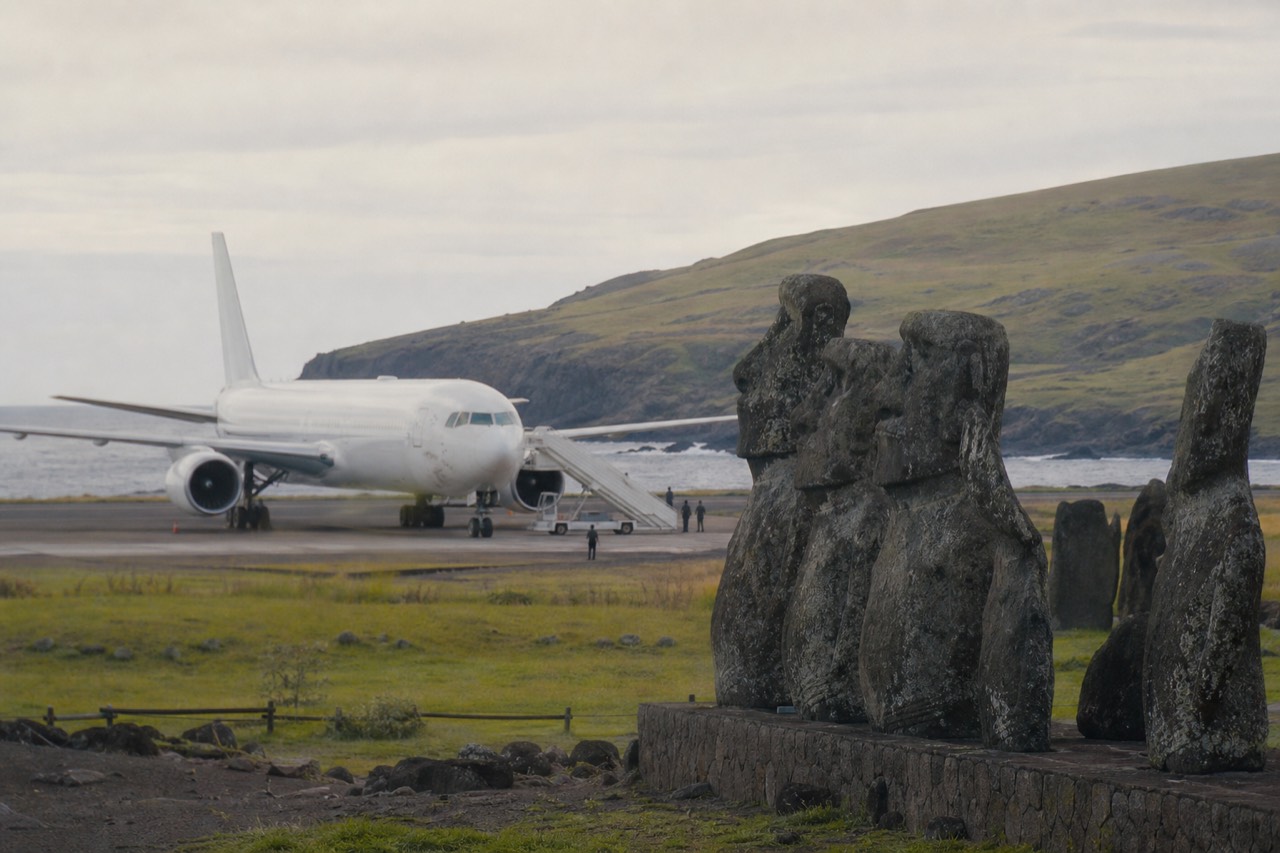
Five and a half hours west of Santiago, the water below the wing has been empty for so long that the first sight of land reads as a mistake. A green triangle appears, roughly seventy square miles of it, with surf breaking on three sides and a runway laid across the narrow southwestern tip. That is Mataveri, and unless you own a boat, it is the only door into Rapa Nui.
This is the part of the trip most people over-research and under-plan. There is nothing to compare: no alliance shopping, no hidden budget carrier, no clever routing through a third country. One airline flies here, on one route, a handful of times a week. What that leaves you to decide is when to go, when to buy, and how many days on the ground the schedule will actually give you, and those three choices swing the cost of the trip by hundreds of dollars.
How do you actually get to Easter Island?
One airline, one route. LATAM flies Santiago (SCL) to Mataveri (IPC) nonstop in about five and a half hours, typically five or more times a week on Boeing 787s, with one or two departures on some days. No other carrier runs scheduled service to the island, and no Tahiti route is currently operating.
The practical consequence of a monopoly route is not just price, it is rhythm. Flights cluster on certain weekdays, and the island's visitor economy runs on that cadence: hotels turn over on flight days, operators fill their vans around arrivals, and Hanga Roa's restaurants get busy on the same evenings. Here, a flight you miss is not a flight you catch that afternoon.
The aircraft matters more than it usually would, too. This is a widebody on a route that would ordinarily see something much smaller, because the leg is genuinely long, over open Pacific, with no diversion airport worth the name for most of it. That is also why the schedule has stayed conservative rather than expanding: the LATAM route page lists it as a Santiago service, and 2026 timetables show no announced reductions or additions of consequence.
Two structural facts flow from all of this and they should shape your whole plan. First, arrival and departure days are half days at best, so a four-night trip is really three usable days. Second, because there is no same-day alternative, everything downstream of the flight, the guided circuits, the sunrise outing, the return connection to your home country, should be built with the flight day as a fixed point rather than a flexible one. Once that is accepted, the rest of the planning gets easy.
What does a Santiago to Easter Island flight cost in 2026?
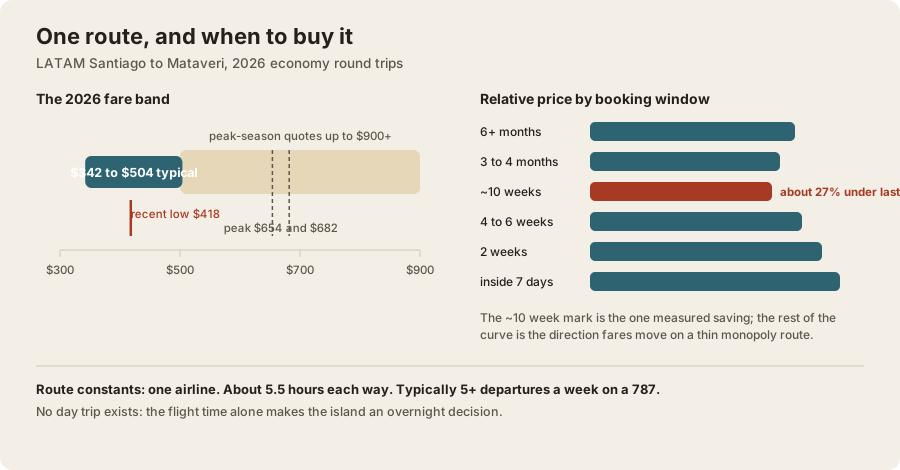
Round-trip economy fares on the Santiago route typically run $342 to $504 in 2026, with recent lows near $418 and observed peak examples around $654 to $682. Broader travel guides quote a wider $500 to $900+ band for peak-season economy. Aggregate 2026 pricing sits roughly 2% below the previous year.
| Demand period | What tends to happen to the fare | Typical round-trip level |
|---|---|---|
| January | Austral summer peak, school holidays, highest demand of the year | Upper band, spikes past $650 |
| February | Still peak, Tapati festival demand in the first half of the month | Upper band |
| March | Warm water, demand easing off the summer peak | Middle of the band |
| April and May | Shoulder, quieter island, softer pricing | $342 to $450 territory |
| June | Off-peak, one of the softest months on record in 2026 data | Low end of the band |
| July | Northern-hemisphere holiday demand pushes it back up | Upper-middle band |
| August to October | Shoulder again, clearest night skies of the year | $342 to $504 typical |
| November and December | Demand builds toward the summer peak, December climbs hard | Rising to upper band |
Two different price stories circulate about this route and both are true, which is why travelers arrive confused. Flight aggregators tracking actual 2026 bookings cluster the round trip in the $342 to $504 range, with a recent low around $418. Destination guides written for planning purposes quote $500 to $900 and up. The gap is not a contradiction: the low figures are what a flexible traveler pays on a shoulder-season Tuesday, and the high figures are what a family locked into the first week of January pays.
What moves the number is almost entirely demand rather than distance. The seat count on this route is fixed by the schedule, and demand is wildly seasonal, so the fare behaves like a concert ticket rather than a commodity. That also explains the spikes: when a peak-week flight starts filling, there is no second flight to absorb the overflow, and the remaining fare buckets go quickly.
One number that surprises people: the flight is often not the largest line in the budget. At $342 to $504 round trip, the airfare from Santiago can be smaller than four nights of mid-range lodging plus the park ticket plus a couple of guided days, especially for two people sharing a room. The full trip budget breaks that arithmetic down properly, and the short version is that the flight is the visible cost while the island is the real one.
When should you book to pay the least?
About ten weeks out. Booking roughly seventy days ahead saves around 27% against last-minute pricing on this route. Earlier than that adds little, because the airline has not yet released its cheaper buckets. Later than that costs real money, since a thin route with no overflow capacity reprices fast as seats fill.
| Booking window | What the market is doing | Practical effect |
|---|---|---|
| 6 months or more out | Schedule loaded, cheap buckets not yet released | Little advantage, but locks a peak-week date |
| 3 to 4 months out | Fares stable, availability wide | Good for January, February and July travel |
| Around 10 weeks out | The measured sweet spot, roughly 27% below last-minute | Best combination of price and choice |
| 4 to 6 weeks out | Cheap buckets thinning on popular days | Still workable in shoulder months |
| 2 weeks out | Repricing steadily upward, popular days gone | Expect the upper band |
| Inside 7 days | No overflow capacity on a thin route | Peak-level pricing, sometimes no seat at all |
The 27% figure deserves a moment because it is unusually actionable. On a $450 round trip, that is roughly $120 per person, which happens to be about the price of a full-day guided circuit on the island. Book at the right moment and the saving pays for a day of the thing you flew here for.
There is a second, subtler reason to book around the ten-week mark, and it has nothing to do with the airline. The FUI entry form, the park ticket and a registered place to sleep all key off your flight dates, and lodging on the island is genuinely limited. Locking flights ten weeks out leaves enough runway to book a Sernatur-registered room, which is itself a legal requirement for boarding, without paying whatever the last available guesthouse asks.

Peak dates break the rule and you should know which ones. The Tapati Rapa Nui festival runs January 30 to February 12 in 2027, its 59th edition, and island accommodation is limited and heavily demanded across it. For those dates, the ten-week window is far too late. Book the flight when the schedule opens, take whatever fare is offered, and treat the saving as a cost of seeing the island's biggest cultural event. Which months are calmest and cheapest covers the seasonal trade properly.
What do you need before you are allowed to board?
Three things beyond your passport: a completed FUI entry form, a non-transferable return ticket, and proof of a Sernatur-registered place to stay or an invitation letter. Every visitor needs the FUI, including Chileans. Maximum tourist stay is 30 days under Law 21.070. The FUI is not a visa.
| Requirement | Who it applies to | Where it happens | Notes |
|---|---|---|---|
| Valid passport or Chilean ID | Everyone | Check-in and arrival | Standard travel document rules |
| FUI / IRN entry form | Every visitor, Chileans included | Online, before your flight | Filed at the official Interior Ministry portal |
| Non-transferable return ticket | Every tourist | Shown at check-in | Fixes your maximum stay at 30 days |
| Sernatur-registered accommodation | Tourists without a local host | Booked before the FUI is filed | Legitimate hotels and guesthouses are registered |
| Invitation letter or sworn statement | Visitors staying with a resident host | Filed with the FUI | Alternative to the accommodation booking |
| Chilean tourist entry, US passport holders | US citizens | On arrival in Chile | No visa needed for tourist entry |
The FUI, formally the Formulario Único de Ingreso, is the piece most first-time visitors miss because it does not exist anywhere else in Chile. It is filed online at the official Rapa Nui entry portal ahead of your flight, and it is checked before you fly rather than after you land. Turning up at Santiago without it is the single most avoidable way to lose a trip.
The accommodation clause catches people too, and it has a logic worth understanding. The island limits tourist stays to 30 days under a specific law, and the way that limit is enforced is through the return ticket and the registered bed. That means you cannot fly out with vague plans to find a room on arrival: the room has to exist, on paper, before you file the form. The Chilean government's Rapa Nui protected-entry pages set out the current documentation, and a plain-language explainer of the entry paperwork covers the edge cases for non-Chilean travelers.
One point of confusion is worth killing outright. The FUI is an entry-control form for a protected territory, not a visa, and it does not replace Chile's ordinary entry rules. US passport holders need no visa for tourist entry to Chile, and they still need the FUI. Whether US passports need a visa for the island works through that distinction in full, including what changes if you are travelling on a different passport.
Is there any other way to reach Rapa Nui?
Not in practice. LATAM's Santiago service is the only scheduled commercial flight to the island, and there is no Tahiti route currently operating. The entry rules make casual non-flight arrival impractical anyway, since every tourist must show a non-transferable return ticket and a registered place to stay before travelling.
The Tahiti question comes up constantly, and it comes up because it used to have a different answer. Travelers still plan Polynesian island-hopping itineraries assuming they can string Rapa Nui between Papeete and South America. Current schedules do not support that: nothing is operating on that link, and building a trip around it is how people end up with an expensive gap in the middle of an itinerary.
Cruise ships and private yachts do call at the island, but they do not solve the access problem for a normal traveler in any useful way. There is no deep-water port, tender operations depend on conditions in an exposed Pacific anchorage, and a ship's call is measured in hours rather than days. The island's headline sites are spread across a national park that requires a ticket and an accredited guide, so a few hours ashore buys a fraction of what a two-day booking does.
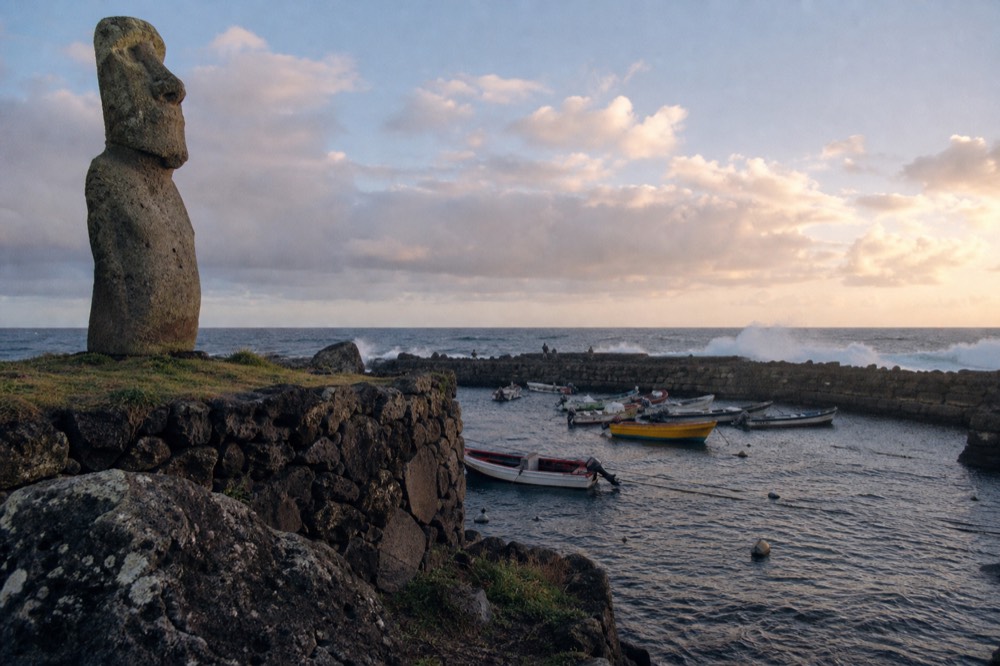
So the honest answer is that the route is the trip. That sounds limiting and mostly is not: a single nonstop out of a major South American hub is a simpler way to reach one of the most remote inhabited places on the planet than almost anything comparable. The flight is the price of admission to a place that stayed isolated precisely because it is this hard to reach.
What happens when you land at Mataveri?
Arrival is quick but sequenced. You clear the entry check with your FUI, collect bags in a small terminal, and buy the national park ticket at the counter if you did not buy it online. Hotels and guesthouses meet arriving flights. Most guided tours begin the following morning rather than on arrival day.
| Arrival step | What to have ready | Typical friction |
|---|---|---|
| Entry check | FUI confirmation, passport, return ticket | Low if the form was filed correctly in advance |
| Baggage | Standard claim in a small single-belt terminal | Fast, the whole flight fits in one hall |
| Park ticket counter | Passport, card or cash, one ticket per person | Buy online in advance to skip the line entirely |
| Accommodation pickup | Booking confirmation | Registered lodgings routinely meet flights |
| Cash | Chilean pesos for taxis and small purchases | Two ATMs in Hanga Roa, they can run dry |
| First tour | Booking confirmation, park ticket already held | Most circuits start the next morning |
The terminal is small enough that the whole process is measured in minutes rather than hours, and that is a genuine relief after five and a half hours over water. The one thing that can slow you down is the park ticket counter, because every foreign adult on that aircraft needs a ticket and a proportion of them will be buying it right there. Buying online beforehand removes the queue and the exchange-rate question at once.
Money deserves a specific warning. The Chilean peso is the working currency, cards are widely accepted in Hanga Roa, and cash is still required for taxis, small purchases and certain spots, with Anakena beach commonly cash-only. Hanga Roa has two ATMs and they can run out, especially on weekends and in high season. Draw pesos in Santiago or take enough to cover the first day rather than assuming the machines will cooperate.
Do not plan a guided circuit for arrival day. The flight lands, the ticket gets bought, the room gets found, and by then the useful daylight for a nine-hour circuit is gone. Save it: the full-day circuits that cover the south coast and the quarry are the reason to be here and they deserve a whole rested day, so it is worth checking what the classic circuit costs for the morning after you land.
How much buffer should you leave in Santiago?
More than you would for a normal connection. Because the route runs five or more times a week rather than hourly, a missed departure is not a delay of hours, it is a delay of a day or more. Treat the island flight as the fixed point of the trip and connect into Santiago the night before wherever the budget allows.
| Connection approach | What a missed island flight costs | Verdict |
|---|---|---|
| Same-ticket international arrival, tight turn | A day or more, plus rebooking on a thin route | Highest risk, do it only if the itinerary forces it |
| Same-ticket international arrival, long layover | Airline handles rebooking, still a lost day | Workable, protection without a hotel bill |
| Separate ticket, same-day connection | Everything, no through-protection at all | The single worst structure for this route |
| Overnight in Santiago before the island flight | Nothing beyond the hotel night | The default recommendation |
| Two nights in Santiago, city time built in | Nothing, and you see the capital | Best value if the itinerary has room |
| Island flight to international departure, same day | Missing your flight home | Leave a night in Santiago on the return too |
This is where the thin schedule bites hardest, and it is genuinely the most expensive mistake available on this trip. Miss a connection on a busy route and you are on the next one in an hour. Miss this one and the next departure may be two days out, on a flight that was already full, in a season where fares reprice sharply. The lodging you booked on the island sits empty, the guided day you paid for happens without you, and the park ticket clock has started.
The fix is cheap by comparison. A night in Santiago before the island flight costs a fraction of what a missed departure does, and it converts a stressful morning into an ordinary one. On the way home, the same logic applies in reverse: land back at Santiago with an overnight before the long-haul flight rather than a two-hour turn.
Separate tickets deserve a specific mention because bargain-hunting travelers build them constantly. If your international flight and your island flight are on different tickets, no airline owes you anything when the first one runs late. On a route with this frequency, that exposure is not theoretical.
How do flight days map to tour days?
Arrival and departure days are half days, so the schedule dictates how much island you actually get. A four-night trip yields roughly three full touring days. Two of those cover the island's headline archaeology, and the third is where sunrise, stargazing or a slower private day fits.
| Trip length | Usable full days | What realistically fits | Best-matched booking |
|---|---|---|---|
| 2 nights | 1 | The south-coast and quarry circuit only | A single full-day circuit |
| 3 nights | 2 | Both main circuits, south coast plus Orongo and Rano Kau | The two-day package |
| 4 nights | 3 | Both circuits plus a sunrise or night-sky outing | The three-day package with Tongariki sunrise |
| 5 nights | 4 | Both circuits, sunrise, stargazing, a beach day at Anakena | Multi-day package plus one add-on |
| 6 nights or more | 5+ | Everything, with weather buffer and unhurried repeat visits | Private days layered onto a package |
| Any length, arrival day | 0 | Airport, ticket, room, dinner in Hanga Roa | Nothing, keep it clear |
The two-night trip is common and it is a genuine compromise rather than a disaster. One properly guided full day covers the toppled ahu of the south coast, the quarry slope at Rano Raraku where hundreds of moai still lie half-carved, the fifteen restored giants at Tongariki, and Anakena. That is the trip most people picture. What it does not include is Orongo, Rano Kau's crater, or any margin at all for the weather to misbehave.
Three nights is where the island starts giving something back, because the second full day picks up the crater rim, the ceremonial village at Orongo, the topknot quarry at Puna Pau and the inland platform at Ahu Akivi. Travelers on that schedule should check what the two-day package costs on their dates, since it covers both circuits under one booking and one guide rather than two separate arrangements.
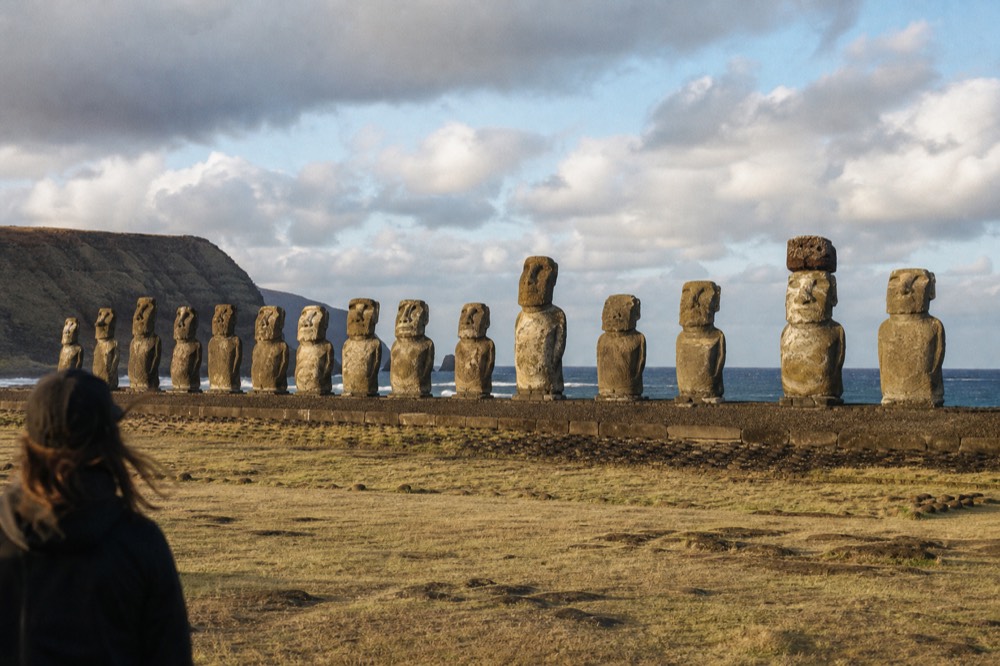
Four nights is the sweet spot for anyone who has flown from the northern hemisphere, and the reason is the third day. Sunrise at Ahu Tongariki happens between roughly 6:30 in the austral summer and 7:30 in winter, and the site opens at 6:00 for dawn visitors. It is the one experience that cannot be squeezed into a circuit day, which is why the three-day itinerary with the dedicated dawn outing exists as a separate product rather than an upgrade.
What does getting there cost in total?
Before you sleep a single night on the island, budget roughly $450 to $600 per person: the round-trip fare, the $100 park ticket, and a Santiago overnight to protect the connection. The FUI form itself is free. Everything above that figure is lodging, food, transport and guided days.
| Line item | Typical 2026 cost per person | Notes |
|---|---|---|
| Round-trip Santiago to Mataveri | $342 to $504 | Peak dates spike past $650 |
| Rapa Nui National Park ticket, foreign adult | $100 | $40 for a foreign child, ten days validity |
| FUI entry form | Free | Filed online before the flight |
| Santiago overnight before the island flight | Varies by hotel choice | Insurance against a thin schedule |
| Airport transfer in Hanga Roa | Usually included by lodgings | Registered guesthouses meet flights |
| Cash buffer for the first day | Pesos for taxis and Anakena | Two island ATMs, both can run out |
| Minimum realistic "getting there" total | About $450 to $600 | Excludes lodging, food and tours on the island |
Seen as one number, the access cost is lower than the island's reputation suggests. What makes Rapa Nui expensive is not the flight, it is everything that happens after the flight: a taxi to Tongariki runs $20 to $30 each way, a scooter is $35 to $50 a day, a 4WD is $60 to $115, and a mid-range dinner is $20 to $40 a head, because almost everything on the island arrived by the same route you did.
The park ticket is the item most likely to blindside you, and not because of the amount. It rose to $100 for foreign adults on October 1, 2025, from $80, and a large share of the travel web has never updated. Anyone budgeting from an older page is $20 per adult short before they start. The full ticket rules, including the single-entry catch explain why the second half of that sentence matters more than the first.
There is one more decision that changes the total, and it is whether you buy the flight and the island days separately or as a bundle. What a Santiago package really includes sets the two structures side by side with the arithmetic, and the answer is not the same for every traveler. If you would rather see the whole booking landscape first, every bookable tour on the island is compared in one place by days, depth and price.
Common questions
Can you fly direct to Easter Island from the United States?
No. Every scheduled flight to Mataveri departs from Santiago, Chile, so a US traveler flies to Santiago first and connects onward. The island leg is about five and a half hours nonstop on LATAM, the only airline serving the route, typically operating five or more times a week on Boeing 787s.
How far in advance do flights to Easter Island sell out?
It depends entirely on the season. Shoulder months such as April, May and August usually have availability inside a month. January, February and July fill much earlier, and the Tapati festival window, January 30 to February 12 in 2027, should be booked as soon as the schedule opens because island accommodation is limited across it.
Do you need the FUI form if you are only staying a few days?
Yes. The FUI applies to every visitor regardless of length of stay, including Chilean nationals. It is filed online before your flight, and it is checked at check-in rather than on arrival. Alongside it you need a non-transferable return ticket and either a Sernatur-registered accommodation booking or an invitation letter.
Is the national park ticket included in the airfare or the tours?
Neither. The $100 foreign adult ticket, $40 for children, is bought separately, either online in advance or at the counter on arrival at Mataveri. No guided tour includes it. It is valid for ten consecutive days, and Rano Raraku and Orongo allow only one entry each per ticket.
How long should the Santiago connection be?
Long enough that a delay cannot cost you the island flight, which in practice means an overnight. Because the route runs five or more times a week rather than several times a day, a missed departure can mean waiting a day or more on a flight that may already be full, while your island lodging and booked tour days pass without you.
Can you visit Easter Island without flying, by cruise or yacht?
Ships do call, but it is not a practical way to see the island. There is no deep-water port, so passengers tender ashore in an exposed Pacific anchorage where conditions can cancel the call, and a stop lasts hours rather than days. The park's main sites require a ticket and an accredited guide, which a short call cannot really accommodate.