Things to do on Easter Island when you have finished with the moai
The statues are why people book the flight, and the crater, the caves, the beach and the sky are what fills the days between the two guided circuits.
Short answer
Beyond the moai, the island's main draws are the Rano Kau crater and the Orongo village on its rim, the lava caves at Ana Te Pahu, swimming at Anakena where the sea peaks at 25 to 27°C in early March, diving to an underwater replica moai sunk in 1994, sunset at Tahai and a night sky with almost no light pollution.
Almost every visitor arrives with the same mental image: fifteen figures on a platform with the sea behind them. Then the guided circuits finish, there is a free afternoon, and the question becomes what else this island actually holds. The answer is more than most itineraries allow for, and a lot of it sits outside the archaeological sites entirely.
Rapa Nui is a volcanic island with a flooded crater a kilometre wide, lava tubes you can walk into, a beach with imported palms and turquoise water, and one of the emptiest night skies on the planet. It also has a food culture built on earth ovens and tuna. None of that requires a moai, and some of it does not even require a guide.
What is there to do on Easter Island besides looking at moai?
Six things, in rough order of how much time they deserve: the Rano Kau crater and the Orongo village on its rim, the lava caves at Ana Te Pahu, a beach afternoon at Anakena, diving or snorkeling on the volcanic coast, an evening astronomy session, and sunset at Tahai. Add Tapati if your dates land on it.
| What you are into | The thing to do | Guide needed? | Half day or evening | Where it fits |
|---|---|---|---|---|
| Landscape and volcanoes | Rano Kau crater rim | Yes, it is inside the park | Half day | Second guided circuit |
| Ceremony and the birdman story | Orongo village, single entry per ticket | Yes | Included in the crater half day | Second guided circuit |
| Caves and lava | Ana Te Pahu | Yes | Half day | Second guided circuit |
| Swimming and sand | Anakena beach and Ahu Nau Nau | No, the beach itself is a practical exception | Half day | Circuit day, or a free afternoon |
| Underwater | Diving and snorkeling, including a sunken replica moai | Through a dive operator | Half day | Free day, weather permitting |
| The night sky | Southern-hemisphere astronomy session | Booked outing | 3.5 hours, evening | Any night, weather and moon permitting |
| Sunset without a plan | Tahai, walkable from Hanga Roa | No | 1 to 2 hours | Every evening |
| Culture at full volume | Tapati Rapa Nui, 30 Jan to 12 Feb 2027 | No | Two weeks | Only if your dates fall in the window |
| Food | Curanto from an earth oven, fresh tuna ceviche | No | Any meal | Hanga Roa |
That table has one column doing most of the work. Anything inside Rapa Nui National Park needs an accredited Ma'u Henua guide, with no independent site visits permitted. Everything outside it, which in practice means Hanga Roa town, the Tahai area and Anakena beach itself, is yours to do on your own schedule. Free days are therefore not free-range: they are days for the beach, the town, the water and the sunset.
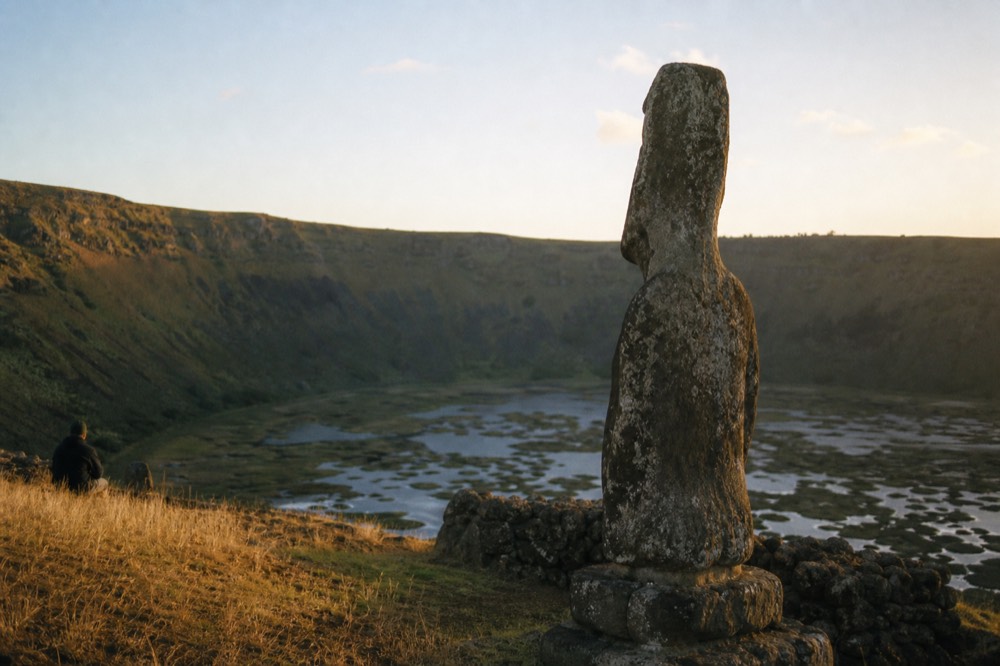
The second thing the table makes clear is how much of the non-moai list lands on the second guided circuit. Crater, ceremonial village and caves all sit on the same loop that most visitors treat as the optional day. Skipping it to save a day is the most common planning mistake here, because it removes almost everything that is not a statue.
Ranking matters less than sequencing. If you have four days, both circuits and one free afternoon, put the beach on the free afternoon and let the guided days carry the crater and the caves. If you have five, the free day is where diving, a second visit to Anakena, or simply an unstructured morning in town belongs. The day-by-day plans show how those pieces fit together across three, four and five-day trips.
Which crater and cave walks actually reward the effort?
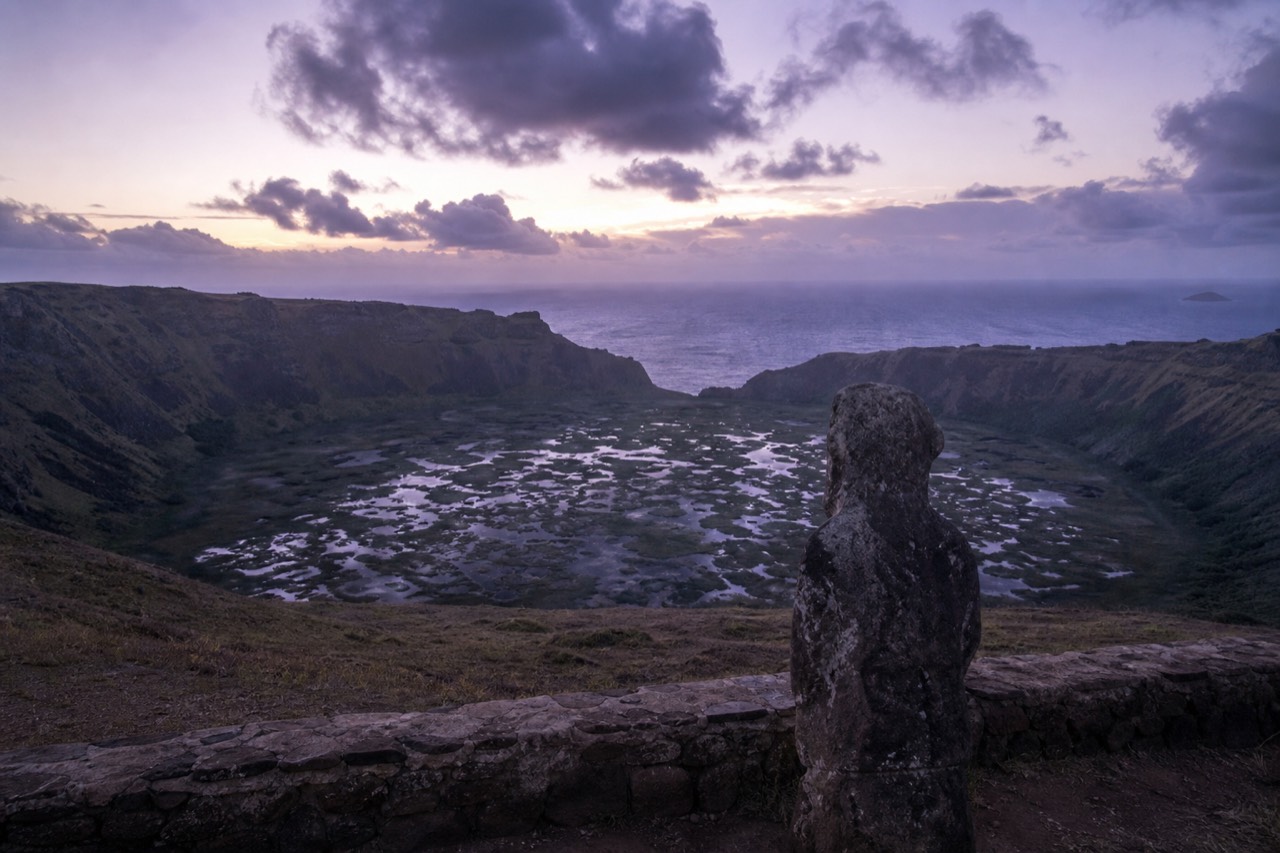
Rano Kau is the single most striking piece of landscape on the island, a wide flooded crater with the ocean visible past the rim, and the ceremonial village at Orongo sits directly on that edge. Ana Te Pahu is the lava-tube counterpoint underground. All three are inside the park, so all three need an accredited guide.
| Site | What it is | Entry rule | Time on a circuit |
|---|---|---|---|
| Rano Kau | Large flooded volcanic crater on the island's southwest | Park site, guide required | Usually the morning of the second circuit |
| Orongo | Ceremonial village on the Rano Kau rim, centre of the birdman tradition | Single entry per ticket, guide required | Same visit as the crater |
| Ana Te Pahu | Lava tube cave system, entered through a collapse | Park site, guide required | Same circuit, usually later |
| Puna Pau | Quarry where the moai topknots were cut | Park site, guide required | Same circuit |
| Vinapu | Ahu known for its finely fitted stonework | Park site, guide required | Same circuit |
| Ahu Akivi | Seven moai facing out toward the sea rather than inland | Park site, guide required | Same circuit |
Orongo is one of only two places on the island limited to a single entry per park ticket, the other being the Rano Raraku quarry. That rule changes how you plan rather than what you see: there is no returning on a clearer afternoon, so the day you go is the day you get. Since Orongo is the rim of Rano Kau, the crater view and the village come as one visit.
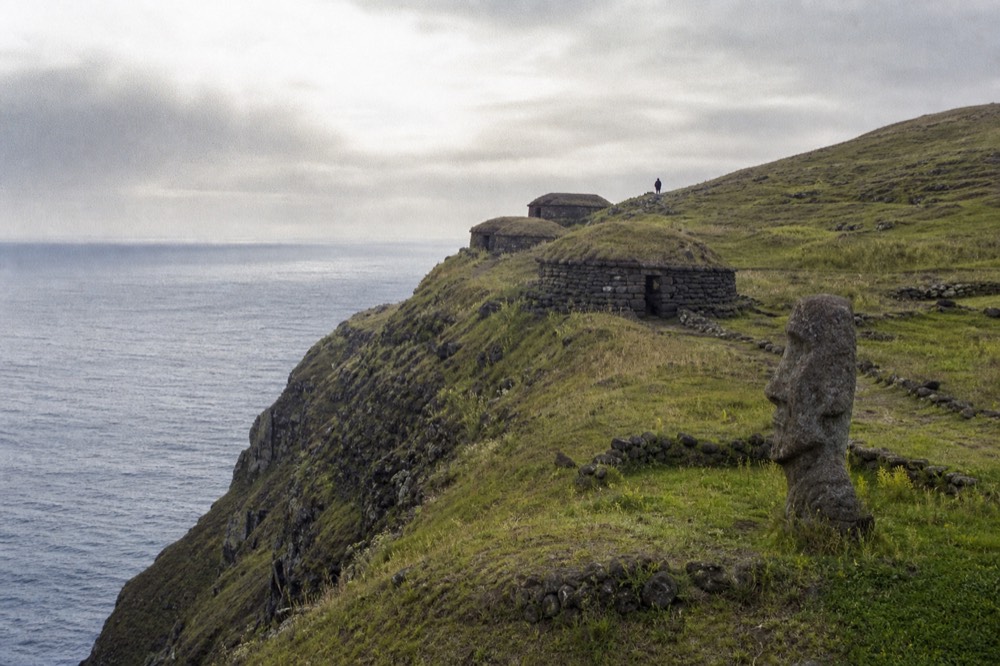
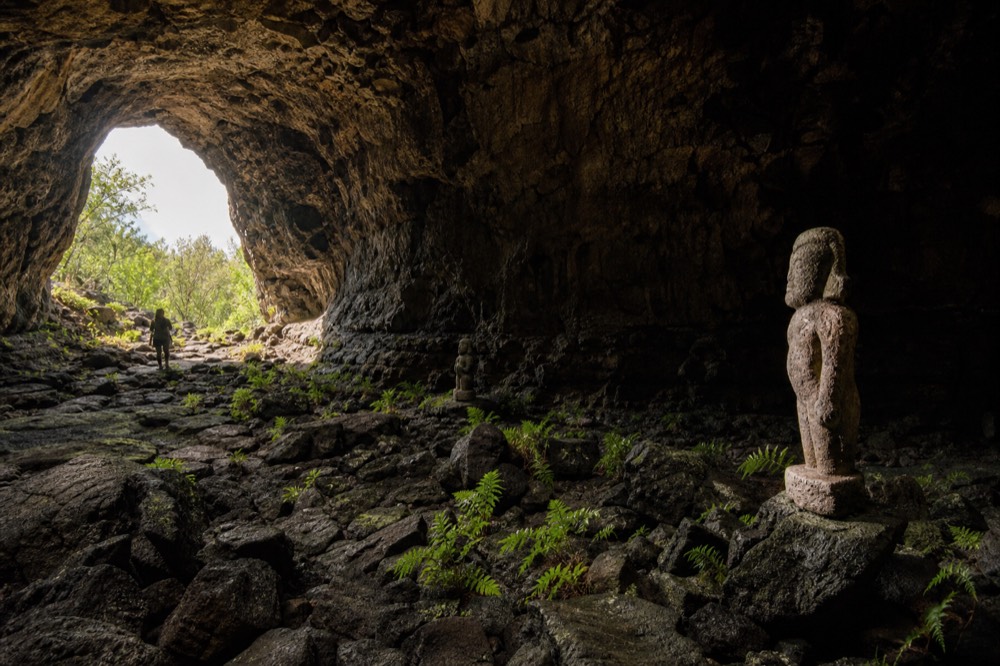
The caves are the part visitors consistently underestimate. Ana Te Pahu is entered through a collapsed section rather than a mouth in a hillside, and the ground above is ordinary pasture until it opens up beneath you. Lava tubes here are not show caves with handrails and lighting, which is why they come attached to a guided day rather than a ticket booth.
The whole park carries the same set of rules and they are enforced. Touching, leaning on or climbing a moai or an ahu is forbidden and carries fines of 5 to 100 UTM under Chile's Law 17.288 on National Monuments. Drones need authorisation. Fires, camping, pets, alcohol and smoking are out. The reasoning behind the no-touching rule is more interesting than the fine, and the park's own conditions are set out on the official park site.
There is a conservation dimension worth knowing before you stand at the quarry. The October 2022 wildfire charred and cracked roughly eighty moai at Rano Raraku, with some reports citing around a hundred and around twenty-two suffering significant damage, and analysis has found subsurface effects up to ten centimetres deep. Physical conservation work led by the Ma'u Henua community began in May 2025 on five of the most fire-damaged statues, using treatments developed with restorers from the University of Florence. The scarring is visible and the work is ongoing. The full moai explainer covers what survived and what did not.
Anakena or Ovahe: which beach should you pick?
Anakena, for almost everyone. It has coral sand, imported palms planted in 1960, the moai of Ahu Nau Nau standing behind the beach, and documented facilities including restaurants, vendors, food trucks and picnic areas. Sea temperature peaks at 25 to 27°C in early March and drops to about 20.5°C in late August. Bring cash.
| Anakena | Ovahe | Hanga Roa waterfront | |
|---|---|---|---|
| What is documented | Restaurants, vendors, food trucks and kiosks, picnic areas, Ahu Nau Nau | Named cove on the same north-east coast; no equivalent facility record | Town shoreline, harbour, walkable |
| Moai on site | Yes, Ahu Nau Nau behind the sand | Not documented | Tahai is a short walk north |
| Sea temperature | 25-27°C early March, about 20.5°C late August, near 20°C on average | Same coastal water | Same coastal water |
| Palms | Planted in 1960, imported | Not documented | Town planting |
| Guide required | No, the beach itself is a practical exception | No | No |
| Payment | Cash; card acceptance is not reliable here | Bring cash | Cards widely accepted in town |
| How you get there | Every full-day circuit ends here; also reachable independently | Add-on stop with transport | On foot |
The Ovahe row is deliberately thin, and that is the honest answer rather than an oversight. Anakena's facilities, its moai and its sea temperatures are all documented; equivalent information for Ovahe is not. The practical consequence is that Anakena is a place you can plan an afternoon around and Ovahe is a stop you can ask a guide or driver to add if the conditions suit.
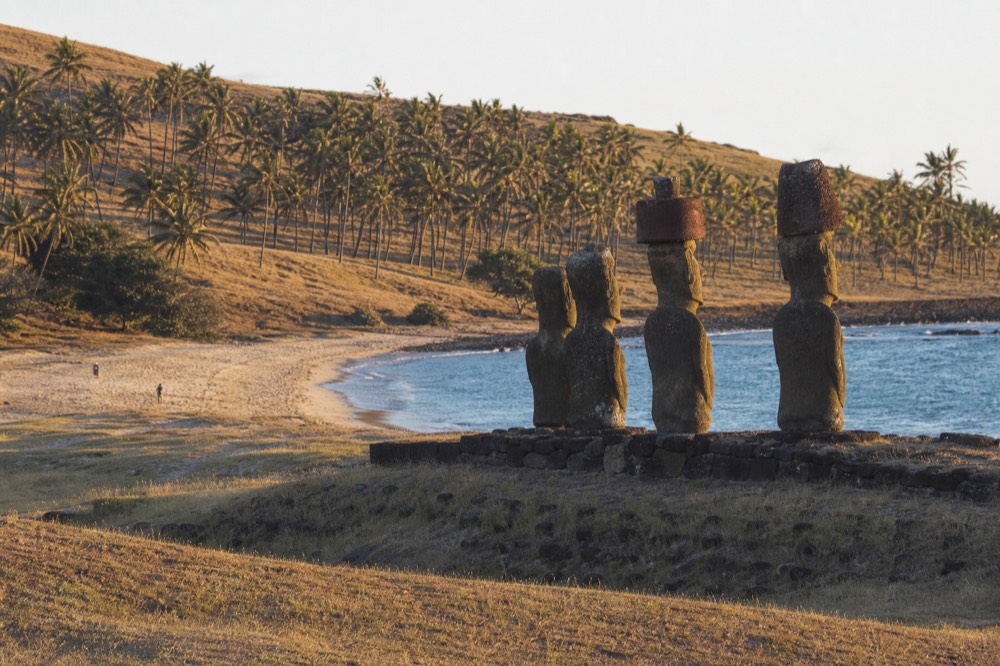
The palms are a good story and a useful correction. They were planted in 1960 and imported, because the island's original palms had largely been lost to deforestation long before European contact. So the postcard image of a Polynesian beach fringed with coconut palms is genuine, recent and deliberate, all at once. Knowing that changes how the place reads.
Timing an Anakena visit is mostly about water temperature and month. Late February and March are the swimming weeks, with the sea at its annual peak. From June to September the water sits nearer 20 degrees and the trade winds are constant, which turns the beach into a walk and a photograph for most people rather than an afternoon in the sea. The month-by-month read has the full temperature curve.
The cash point catches people out. Anakena runs on cash, Hanga Roa has two ATMs that can empty at weekends and in high season, and cards are widely accepted in town but not everywhere. Withdraw before the beach day, not during it. What currency the island uses covers pesos, dollars and where each is accepted.
What can you do without a guide?
Three things, and they are genuinely good ones: Hanga Roa town, the Tahai area, and Anakena beach itself. Everything inside Rapa Nui National Park, meaning the quarry, Tongariki, Orongo, Rano Kau, the caves, Akivi and the rest, requires an accredited Ma'u Henua guide. There are no independent site visits.
| Activity | Independent? | What it costs | Notes |
|---|---|---|---|
| Sunset at Tahai | Yes | Free | Practical exception to the guide rule; walkable from town |
| Hanga Roa harbour and town | Yes | Free | Shops, banks, restaurants, the island's only settlement |
| Anakena beach and swimming | Yes | Transport plus cash on site | Beach itself is the exception; the ahu is still park land |
| Rano Raraku quarry | No | Park ticket plus a guided day | Single entry per ticket |
| Ahu Tongariki | No | Park ticket plus a guided day | Not single entry; a dawn return is possible |
| Orongo and Rano Kau | No | Park ticket plus a guided day | Single entry per ticket |
| Ana Te Pahu caves | No | Park ticket plus a guided day | Reached on the second circuit |
| Diving and snorkeling | Through an operator | Operator pricing | Conditions depend on daily swell |
| Astronomy session | Booked outing | From $140, 3.5 hours | Meets in Hanga Roa, drop-off included |
| Renting a scooter or 4WD | Yes | $35-50 a day scooter, $60-115 a day 4WD | Useful for free days, not a way into the park |
The rental question comes up constantly and the answer is unintuitive. Hiring a Jimny does not unlock the park, because the constraint is the guide requirement rather than transport. What a vehicle buys is freedom on the days you are not on a circuit: a self-paced run to Anakena, the coast road, an afternoon that starts when you want it to. Taxis to sites like Tongariki run roughly $20 to $30 each way, which for one round trip is cheaper than a day's rental.
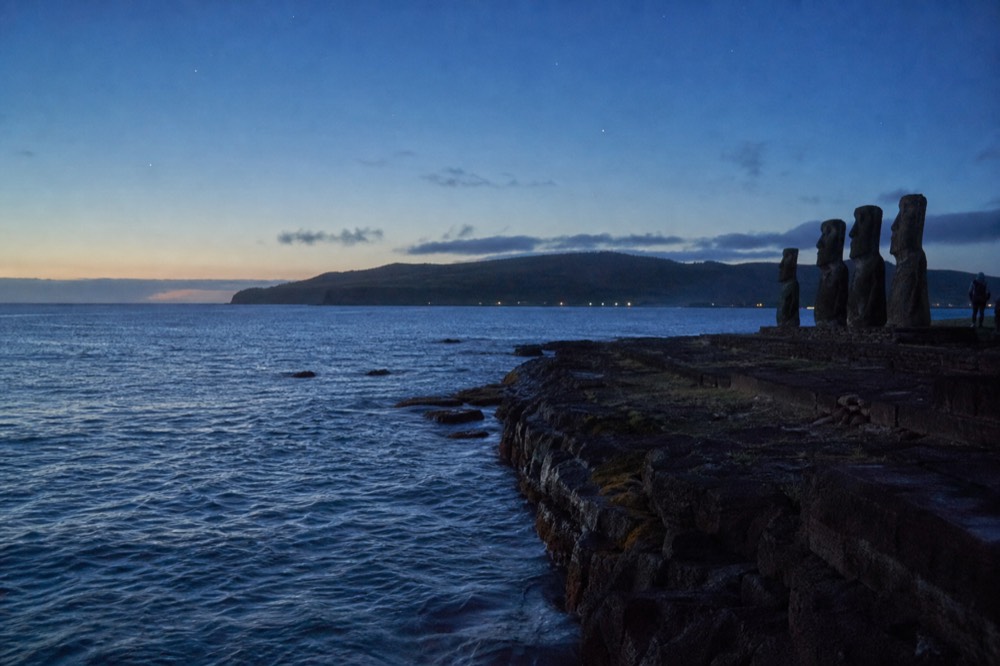
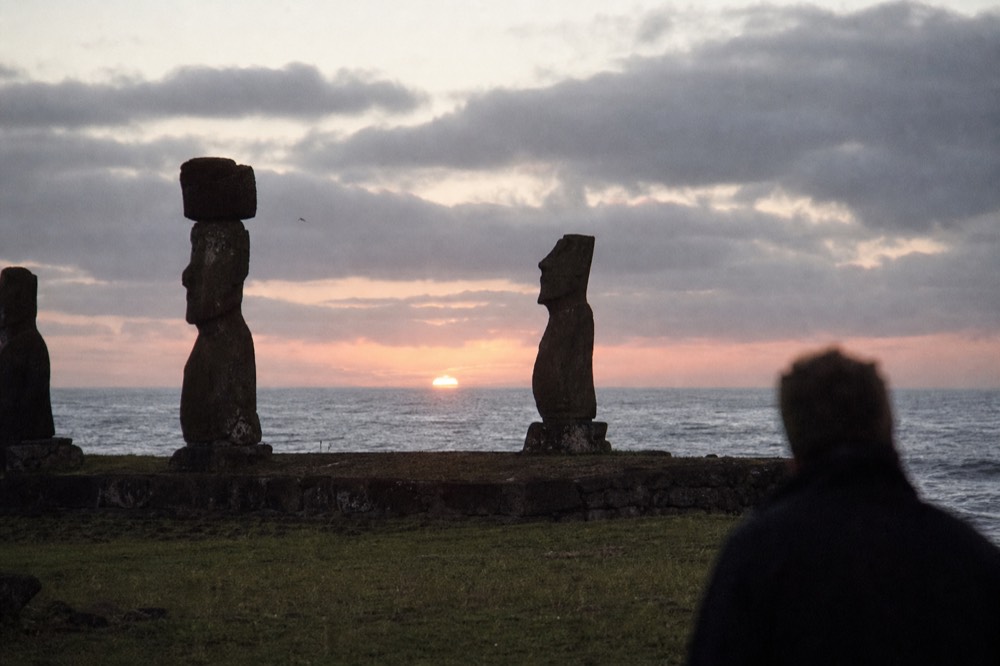
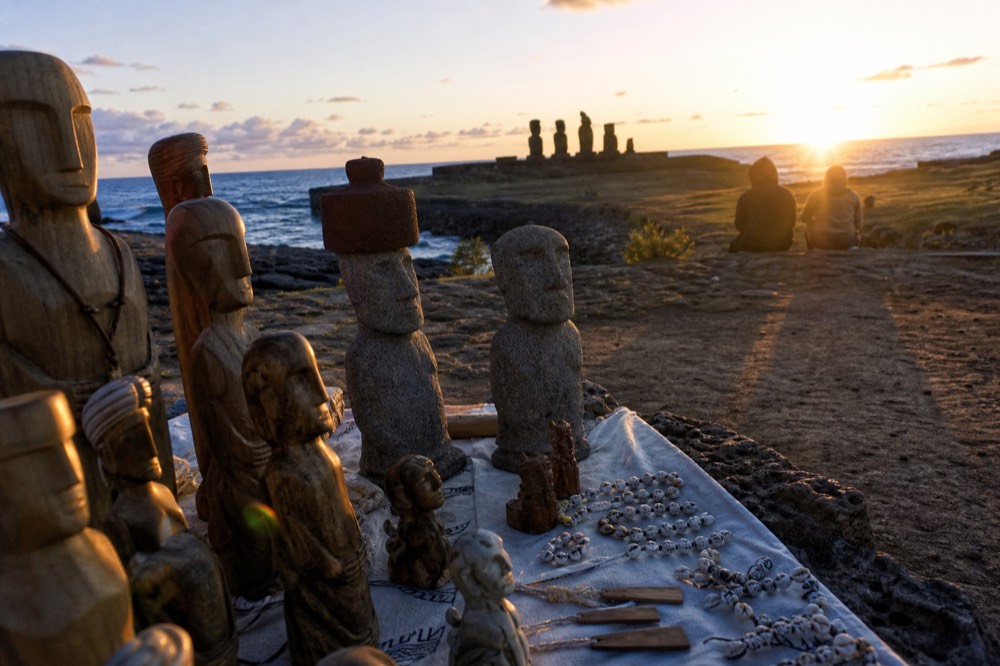
Tahai deserves better than its usual one-line mention. It is close enough to walk from most of Hanga Roa, it costs nothing, it has moai, and it faces the right way for sunset. That combination means it can be done on the arrival evening when you are too tired to do anything else, and again on the last night, and it will not feel repetitive either time.
For visitors who want the guided sites without the convoy feeling, the variable to shop on is group size rather than itinerary, because most operators run a near-identical stop list. Small-group days keep the vans light and leave room for actual questions at each stop, and it is worth seeing what the boutique small-group day includes on your dates if a crowded quarry visit would spoil it. For a day built specifically around the caves and the ceremonial village rather than the standard arc, the ancestral caves and Orongo day is the narrower option.
Is the diving and snorkeling worth a half day?
Yes, with one honest caveat. The water is volcanic rather than reef-rich, and there is a genuine curiosity down there: a replica moai sunk offshore for a 1994 Hollywood film that has become a dive site. What no reliable source publishes is a visibility figure, so treat any specific number you are quoted as marketing rather than data.
| Factor | What is actually known |
|---|---|
| Sea temperature, summer | 25-27°C (77-81°F) around early March |
| Sea temperature, winter | About 20.5°C (69°F) in late August |
| Year-round average | Near 20°C |
| Signature dive site | An underwater replica moai, sunk for a 1994 film |
| Visibility figures | Not verifiable in published sources; ignore precise claims |
| Conditions | Driven by Pacific swell and wind rather than by month |
| Sheltered side | The north and east, where Anakena sits |
| Best months for water comfort | Late February to March, at the sea temperature peak |
The sunken moai is the thing people ask about and the thing most easily misunderstood. It is not an archaeological object and it never was: it was made and sunk as a film prop in 1994. That does not stop it being an unusual dive, and it is honest about what it is, which is more than can be said for some of the stories attached to it online.
Snorkeling is the lower-commitment version and Anakena is the obvious base for it, because the north-east side is the sheltered one when the south coast is working. The south coast is exposed to Pacific swell and wind, and its state on any given day has more to do with the weather chart than with the season, which is why water plans should be flexible on the morning rather than fixed weeks out.
The temperature swing is the deciding factor for most visitors. Nearly seven degrees separates late August water from early March water, and that is the difference between a wetsuit conversation and a straightforward swim. Anyone building a trip around the water should read the seasonal temperature curve before fixing dates.
One practical note. Because the free day is where diving fits, and because the free day only exists on a four or five-day itinerary, water plans are effectively a function of trip length. Three-day visitors will not get in the sea except for an hour at Anakena on the circuit day, and that is fine, but it should be a decision rather than a surprise.
What is there to do after dark?
Three options and one of them is genuinely world class. The island sits roughly 2,200 miles from the nearest city with minimal light pollution, so the southern sky here shows constellations, planets and the Milky Way that never rise from northern latitudes. Otherwise: sunset at Tahai, and dinner in Hanga Roa at $20 to $40 a head.
| Evening | What it involves | Cost | Timing note |
|---|---|---|---|
| Astronomy session | 3.5 hours, telescopes, southern-sky constellations and Polynesian navigation history | From $140, 4.5 across 64 reviews | Clearest April to October; runs around the moon calendar |
| Sunset at Tahai | Short walk from town, moai facing the sea | Free | Every evening, no booking |
| Dinner in Hanga Roa | Seafood, tuna, local cooking | $20-40 per person, mid-range | Imports push prices above mainland Chile |
| Tongariki at dawn | Not an evening, but it sets one: gate opens 6:00 am | Part of a dawn outing | Sunrise about 6:30 am Dec-Feb, 7:30 am Jun-Aug |
| Tapati evenings | Festival programme, 40+ activities across the fortnight | Varies | 30 January to 12 February 2027 only |
The astronomy session is worth taking seriously rather than treating as a filler activity. It runs three and a half hours, meets at the Katipare library in Hanga Roa, includes a hotel drop-off and heads out toward a dark site near Anakena, with telescopes and a presentation covering Polynesian navigation as well as the sky itself. It is weather-dependent by nature, and it runs around the moon calendar, because a full moon washes out exactly what you came for.
Two practical points follow from that. Book the session for a night early in the trip so a clouded-out evening can be rescheduled, and expect it to be cold: the wind comes straight off the open Pacific and you will be standing still. Anyone planning around the sky should check which evenings the astronomy session is scheduled as soon as the dates are fixed, and the southern-sky guide covers what is actually visible from this latitude.
What you will not find here is nightlife in the resort sense, and most visitors count that as a feature. The evening rhythm is dinner, a walk, and either an early night before a dawn start or an hour looking up. On an island with one town and no light pollution to speak of, that is exactly the right shape for a trip.
What should you eat on Rapa Nui?
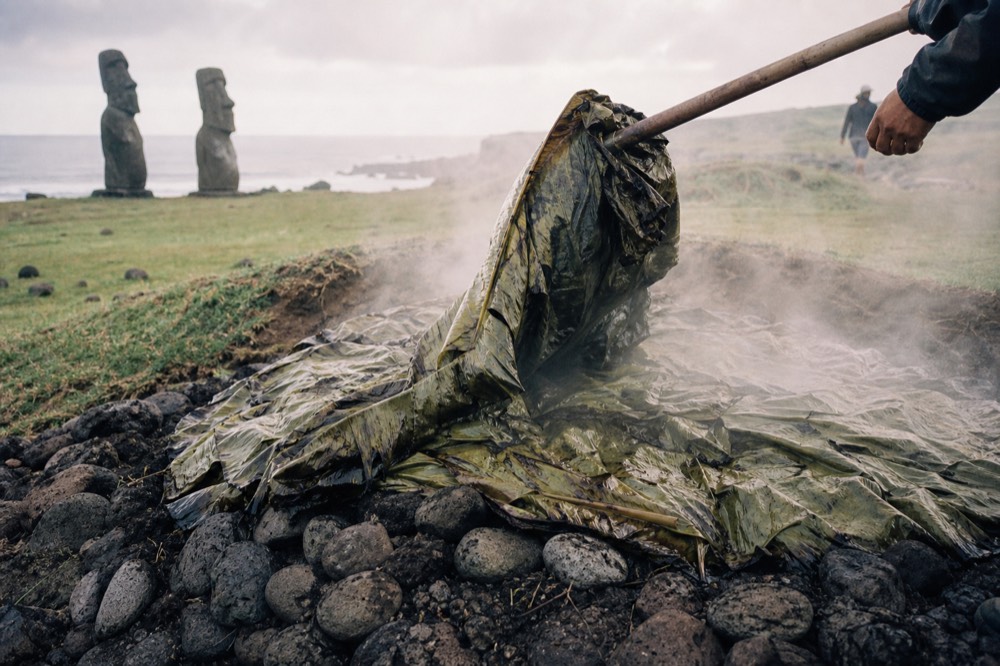
Two dishes define the island's table. Curanto, also called umu rapa nui or umu pae, layers meat, chicken, fish, seafood, vegetables and tubers like sweet potato and taro under banana leaves in an earth oven over hot volcanic stones. Fresh tuna ceviche, raw fish marinated in citrus and herbs, is the everyday signature.
| Dish | What it is | Where it fits | Note |
|---|---|---|---|
| Curanto / umu rapa nui / umu pae | Meat, chicken, fish, seafood, vegetables and tubers slow-cooked in an earth oven on hot volcanic stones under banana leaves | A planned meal rather than a walk-in | The island's signature communal cooking method |
| Fresh tuna ceviche | Raw fish cured in citrus with herbs and local accompaniments | Everyday, most seafood menus | The dish most associated with Rapa Nui cooking |
| Sweet potato and taro | Tubers used in the earth oven and alongside main dishes | Side dishes across the island | Part of the Polynesian food base |
| Mid-range dinner generally | Seafood-led menus in Hanga Roa | $20-40 per person | Higher than mainland Chile because almost everything is imported |
| Where people rate highly | Recent reviews single out spots such as Neptuno Sunset and Te Moai Sunset for seafood and ceviche | Hanga Roa | Reputations move; check current reviews on arrival |
Curanto is the one to plan for rather than stumble into. Cooking in an earth oven takes hours and serves a group, so it works as an arranged meal rather than something you order on a whim at nine in the evening. Ask at your accommodation early in the stay if you want it, rather than on the last night.
The price line is structural. Almost everything that is not fish arrives by air or sea, so a mid-range dinner at $20 to $40 a head is normal here and cheaper than it looks once you account for the freight. Fish is the exception and the reason ceviche is the local default: it is the one ingredient the island does not have to import.
Tipping is appreciated rather than expected, with around ten percent noted at restaurants. Cards are widely accepted in Hanga Roa, but cash still matters for smaller spots, taxis and Anakena, and the town's two ATMs are known to run out of cash at weekends and in busy periods.
What changes if you are here during Tapati?
Tapati Rapa Nui 2027 runs 30 January to 12 February, the 59th edition, with more than forty cultural and artistic activities and competitions across the fortnight. It is the island's own festival rather than a show put on for visitors, which is exactly why it is worth seeing and exactly why beds and flights get tight.
What changes during those two weeks is everything except the park. The cultural programme fills the island, accommodation stock tightens and prices climb, and the dates sit inside the January to early February fare peak on the Santiago route. Vehicles and accredited guides go into heavy use, so guided days need booking well ahead rather than the few weeks that usually suffice. The weather is at its warmest, with air near the annual high and the sea approaching its March peak. Outside the festival, the same island is quietest from June to September, off-peak for fares apart from July, and bookable at much shorter notice.
The mistake to avoid is treating Tapati as a bonus that happens to overlap your trip. It reshapes the logistics of the whole fortnight, and the binding constraint is beds rather than seats, because the island has one town and a finite number of registered places to stay. If the festival is the goal, book a bed first and work outward. The 2027 programme and dates are the reference.
Nothing about the park system changes during the festival. The $100 adult ticket, the ten consecutive days of validity, the single-entry limits at Rano Raraku and Orongo and the accredited-guide rule apply exactly as they do in September. The island's UNESCO listing covers around three hundred ceremonial platforms, and the management framework behind them does not pause for a fortnight.
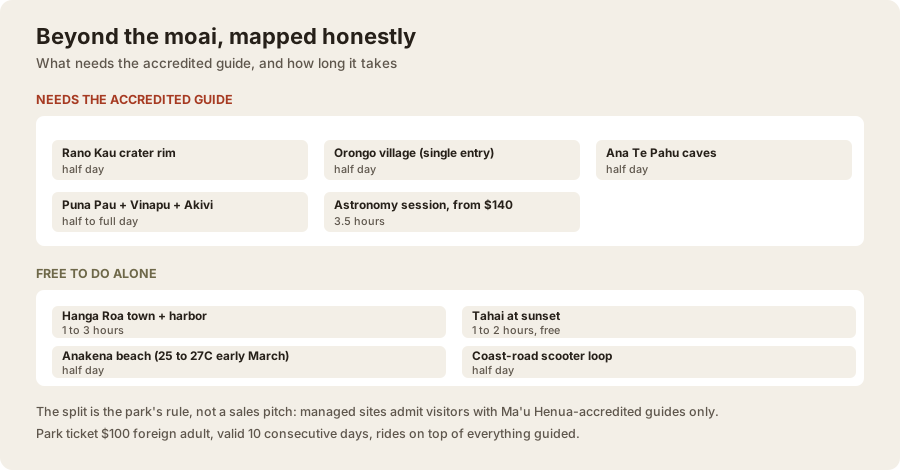
Most of this list resolves into one planning decision: how many guided days you buy and what you do with the gaps between them. The single full days cover one circuit each, and every bookable tour on the island sits in one place if you would rather compare the whole lineup than pick from a shortlist. Whatever shape the trip takes, the ten-day park ticket and its single-entry sites are the constraint everything else has to fit around, and the island's UNESCO World Heritage listing explains why those rules exist at all.
Common questions
Can you walk to any moai without a guide?
Yes, at Tahai. The Tahai area, Hanga Roa town and Anakena beach itself are the practical exceptions to the guide requirement, and Tahai is close enough to walk from most of town, faces west for sunset and costs nothing. Everything else inside Rapa Nui National Park, including the quarry, Tongariki, Orongo and the caves, requires an accredited Ma'u Henua guide.
Is Anakena worth a full afternoon?
In late February and March, yes: the sea peaks at 25 to 27°C and the beach has restaurants, vendors, food trucks and picnic areas alongside the moai of Ahu Nau Nau. From June to September the water sits near 20.5°C and the trade winds are constant, which makes it more of a walk and a photograph. Bring cash either way, because card acceptance there is not reliable.
How good is the stargazing really?
Very. The island's isolation and minimal light pollution mean the southern sky shows constellations, planets and the Milky Way that never rise from northern latitudes, and sessions include telescopes plus Polynesian navigation history. Skies are clearest from April to October and outings run around the moon calendar. No source publishes a formal darkness rating for the island, so ignore any specific class number you see quoted.
Is there really a moai underwater?
There is, and it is a replica. It was made and sunk offshore for a Hollywood film in 1994 and has since become a dive site in its own right. It is not an archaeological object and was never intended to be one. Published visibility figures for the site are not verifiable, so treat precise numbers in listings with caution and ask the operator on the day.
What is curanto and can visitors try it?
Curanto, also called umu rapa nui or umu pae, is meat, chicken, fish, seafood, vegetables and tubers such as sweet potato and taro, layered under banana leaves and slow-cooked in an earth oven over hot volcanic stones. It takes hours and serves a group, so it is arranged rather than ordered on the spot. Ask at your accommodation early in the stay rather than on the final night.
Do you need to rent a car to see the island?
Not for the park, since entry requires an accredited guide regardless of transport. A rental only helps on free days, for Anakena, the coast road and moving around outside the park. Scooters run $35 to $50 a day and a compact 4WD $60 to $115, while a taxi to a site like Tongariki is roughly $20 to $30 each way, which usually wins for a single round trip.